L a - b e a u t é - s a u v e r a - l e - m o n d e ~ D o s t o ï e v s k i

L a - b e a u t é - s a u v e r a - l e - m o n d e  ~  D o s t o ï e v s k i


Monday, September 23, 2013

Contessa Anastasia Spini by Giovanni Carnovali


A portrait of Contessa Anastasia Spini by Giovanni Carnovali - called il Piccio - 1838/40


Sunday, September 22, 2013

Sapphires and emeralds - new and "previously owned" merchandise


As Grand Duchess Maria Pavlovna (the "younger") prepared for her 1908 wedding to Prince Wilhelm of Sweden, Duke of Södermanland, her father, Grand Duke Paul Alexandrovich, ordered a magnificent sapphire and diamond parure from Cartier.  This included a tiara, corsage ornament, and necklace.  The necklace can be seen in the photographs below where, since married, the then Duchess of Södermanland is wearing Swedish court dress.  (The black velvet of the court robes was a convenient camouflage; the duchess was pregnant at the time with her son, Lennart, who was born in 1909.)  The marriage was unhappy and they divorced in 1914.  I don't know the eventual fate of this parure.  Most likely, like her more famous emeralds, she was forced to sell them, while living in exile after the revolution.  Also, more than likely, they were subsequently dismantled and used for other less prestigious adornments.


At that time of the commission, Grand Duke Paul was living in exile in Paris with his second - and morganatic - wife and their three children.  His first wife, Grand Duchess Alexandra Georgievna, née Princess Alexandra of Greece, died giving birth to their son, Grand Duke Dmitri Pavlovich.  Because of the scandal of the affair with and subsequent marriage to Olga, madame von Pistohlkors (later Countess Hohenfelsen, later Princess Paley), they were forced to leave Russia, and Maria and Dmitri were left in the care of Paul's brother, Grand Duke Sergei Alexandrovich and his wife, the great beauty and sister of Tsaritsa Alexandra, Grand Duchess Elisaveta Feodorovna.  After the assassination of her husband in 1905 Grand Duchess Elisaveta decided to become a nun.  In preparation for this great transformation and in order to help pay for the establishment of a convent, she gave much of her celebrated jewelry to relatives and sold the rest.  One of the pieces she gave to her ward, Maria Pavlovna, was a necklace of diamond links.  It can be seen below in a photograph of Grand Duchess Elisaveta and, again, in the third and forth pictures above, worn above Maria Pavlovna's sapphire necklace.


***
 

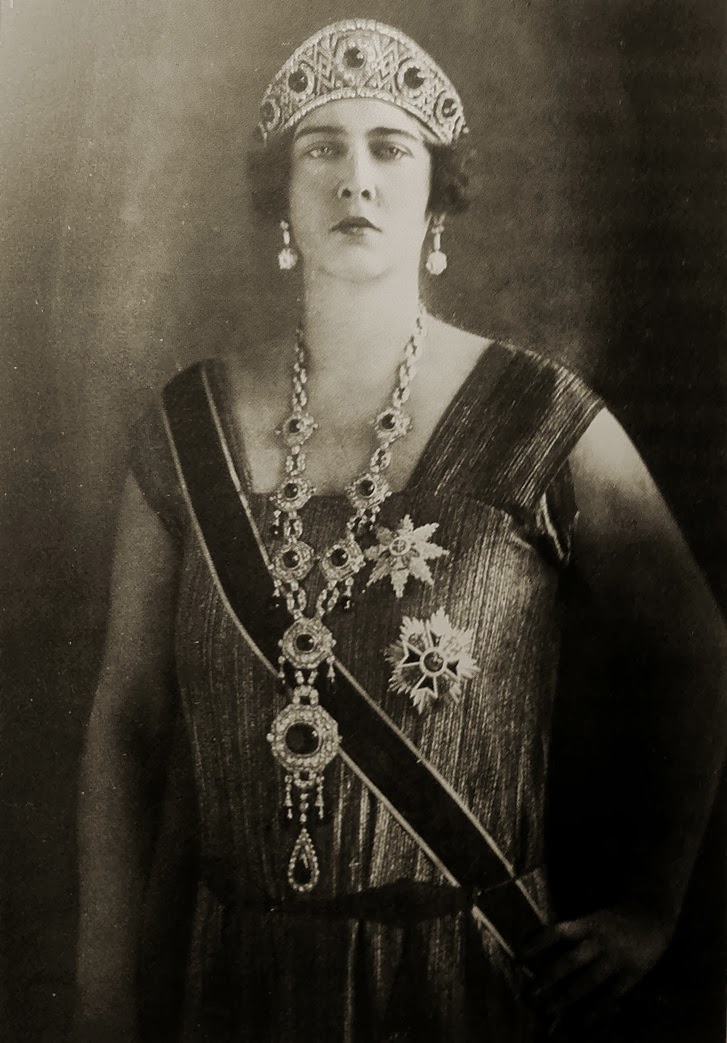
As for the "more famous emeralds", these were also given to her by her aunt.  A tiara and necklace, and perhaps other pieces that I haven't seen documented.  The central section of the necklace could be detached and worn as a brooch, as it most often was.  I've only ever seen one photograph of the Grand Duchess Elisaveta wearing the tiara - and that taken at a distance - but like most large and "important" jewels, sections could be detached and used in other ways.  The large diamond-ringed cabochon emeralds from the tiara are visible as "buttons" down the front of her court gown in the first image below, and as ornamentation for her traditional kokoshnik in the second two.

Grand Duchess Maria Pavlovna, in Russia following her divorce, wearing the tiara and necklace.

After escaping revolutionary Russia, Maria Pavlovna found refuge in Roumania, where her flamboyant first cousin, Marie, was queen.  In the depths of World War I, Queen Marie had sent her jewelry to her ally Russia for safekeeping.  An unwise decision as it turned out; before the war was even over, the revolution in Russia had broken out, and the victorious Bolsheviks were not at all inclined to return her jewels.  Having three daughters approaching a marriageable age, and with an outsized love of adornment, herself, she set about buying up a large portion of the jewelry that her near relatives, newly exiled, were so eager to sell.  Queen Marie purchased the tiara and necklace to give to her daughter who was soon to marry King Alexander of Yugoslavia; "Mignon", as she was called in the family, wore the necklace pinned to the neckline of her gown on her wedding day.  (I should mention that I've also read that it was the King, himself, who bought the emeralds for his bride.  I'm not certain which story is accurate.)


Subsequently, the necklace was broken up and the stones reused to create a heavy sautoir by Cartier.


 Both necklace and tiara were later sold.  I don't know the fate of the necklace, but the tiara still exists in the collection of Van Cleef & Arpels.  The emeralds have been replaced with paste copies.


By an unknown artist

"Portrait d’un homme et de ses enfants" circa 1810.  Musée de Tessé.


This is a painting I absolutely love.  Formerly titled "Le Conventionnel Michel Gérard et sa famille" or "La Famille de Michel Gérard", and residing at the Musée de Tessé since the end of the nineteenth century, it is now just referred to as a portrait of a man and his children.  This expertly made work was formerly attributed to David but, though various experts have tried to fit it into the oeuvres of other likely artists, the painter remains unknown.

I like to imagine that it was painted by the missing wife and mother of this family.  First, because then - and, to a degree, still - female artists, no matter how accomplished they might be, weren't taken as seriously as male artists.  Also, "propriety" would lessen the likelihood that a woman painter would actually become a professional, with her work publicly exhibited.  So it isn't hard to imagine that the author of this work would be little recognized in her own time and then quickly forgotten.

But I think what really shapes my hopeful hypothesis is how understood all the figures in this portrait are.  Each person is so particular.  Their expressions, their gestures.  And even more than that, how they relate to each other.  The direction of their gaze, the way they touch each other, crowded together in the picture plane.  The rough-hewn father, jacket-less with his sleeves rolled up, smiling gently and holding his youngest son, his large hand lovingly at the boy's waist.  The boy, looking over at his sister at the clavier, with maybe a hint of jealousy or resentment in his dreamy gaze.  The girl looks up from playing, and so much can be read into her expression.  Is she just a little proud of her accomplishment?  Or is that the timeless "oh, mother...!" look in her eyes?  Behind, the eldest boy looks self-assured - or at least the self-assurance assumed by a young man just coming of age - his left hand tucked into his jacket.  He has his right arm protectively draped over the shoulder of the middle brother, a boy who seems so shy - almost completely in shadow, his head tilted downward - that he nearly disappears from the painting.

I've never been able to find a larger image of this painting - or seen it in person, of course - so I can't comment on the finesse of the actual painted surface or all the described details.  (I'd love to know what is written on the card or slip of paper that is tucked into the mirror frame.)  There are certainly many, many portraits that are more graceful or grand or technically adept.  But I can think of very few that come close to this in the way it portrays the real connection and love of a simple family.

Trying harder

I'm afraid I've gotten very lax in keeping up with this blog.  I used to post rather frequently.  But now there never seems to be enough time.  I'm very - blessedly - busy with art projects.  And I'm sure I'm often put off posting by my understanding of my own nature, that I'm such a perfectionist, so pedantic and driven to tell "the whole story", that I know I'll spend far too much time on any given post, once I'm inspired by something, something that I want to share.  And I just do not have enough time for that right now.

So I thought I'd try and do what a lot of other bloggers do: post images that I think are interesting and/or merely beautiful, with very little in the way of explanatory text; I'll try my damnedest to keep it brief.  I am a visual artist, après tout, and there are always wonderful images that I stumble upon, things that fascinate me.  These images exemplify my aesthetic, are examples of what feeds my imagination as an artist, so why shouldn't I share them?

Et voilà, I know nothing about this photograph; the file title only says, "For Whit".

Tuesday, July 30, 2013

Stumble and grace


When hiking up in Forest Park, I'm continually astounded that many, if not most, of those whose path I cross are runners.  The Wildwood Trail is beautiful, but with all the tree roots and rocks popping out all over the place, it can be more than a little dangerous unless you're paying very close attention to where you land your feet.  The photos above give some idea, but even more dangerous are the little root-y hazards that aren't at all so obvious; I've tripped so many times on the subtlest bits of root that, with the fallen leaves and dappled light, I could barely make out against the same-colored surface of the path.  

And yet all these people keep flying by me, their heads thrown back, seemingly unconcerned with any potential leg-breaking or tooth-scattering disaster.  Maybe when they really get going properly, there's a bit of elevation, and their toes don't catch on things so much.  Or maybe their feet have a sort of sixth sense for all the roots and rocks and are able to avoid them without much effort.  Kind of like the happy relationship I had with dog poop in Paris; I seemed to have the most excellent radar and never put a foot wrong.

But up on the trail I'm so prone to stumbling that I can't but gaze down at the ground in front of me the whole way; if I want to revel at the glory of nature - or take a necessary swig of water - I pretty much have to come to a complete stop.  I think maybe I don't lift my feet very much when I walk.  Perhaps I've got a bit of a "Versailles glide", that peculiar gait used by the ladies of the French court, moving across the parquet without lifting their feet, seeming to float rather than walk.

Yes, that must be it.


 (I don't think Norma has quite got the "glide", here, but I believe you get my point....)


Saturday, June 15, 2013

With a Song in My Heart - alternate casting

When I was a kid, there were quite a few films that I saw multiple times on television.  Those were the days, in the 60s and 70s, when they played old movies in the afternoon and late at night, times when I was very likely to be watching.  There were certain of them that influenced me greatly, that helped shape - or warp - my young, impressionable mind.  The King and I, Wuthering Heights, Astaire and Rogers' films, Jeanette MacDonald and Nelson Eddy films were some of them.  Later, films like The Leopard and The Go-Between.  One of the big ones for me was With a Song in My Heart, starring Susan Hayward, the "biopic" of singer Jane Froman, filled with glamorous musical numbers and a whole lot of suffering:  the struggles she endured after being severely injured in a plane crash during WWII, the worry over whether they'd be able to save her crushed leg, and whether she'd ever walk again.  Great stuff.  The always wonderful Thelma Ritter is in much of the film, too, playing Froman's fictional nurse and confidant, Clancy.

During the recovery from my recent - not really severe, at all - injuries, mostly to my knee, my dear G has been a sort of real-life Clancy, doing everything for me, keeping us going.  As hard-working and good-tempered as she's been, through all of this, I couldn't help but think of that other plucky nurse.  Also, when the situation really started getting me down, and I felt like abandoning myself to full-throttle whining, I would think about the real suffering of Froman and compare it with my own situation, then compare both with the beautiful Hollywood suffering of the film version, and it'd be enough to tamp down some of my drama queen tendencies and make me laugh at myself.  Yes, all my pain will be redeemed and - some day - my leg brace will come off and... I'll walk!

Not surprisingly, for G's birthday, yesterday, I'd planned on a nurse theme for her card.  Something pretty simple.  But then I imagined a Photoshop sequence based on one of my favorite scenes from the movie.  Then I realized that I didn't have enough time to finish and still be able to give it to her on her birthday morning, so I reverted to the original plan.  Luckily, I then had enough time during the day to finish this second one, as well.  I gave it to her last night at dinner.

If you've never seen the movie... well, hmm... maybe what follows will make no sense at all.  Sorry if that's the case.  You should rent it; highly recommended.

***

(This scene comes when Jane is in the hospital again, at her lowest ebb, when it looks like they might have to amputate.  I've used some of the actual dialogue from the scene.)


And then this is my little craft project for putting the images together into some sort of a card-like format.  All very last minute - and totally unplanned - but it came out OK in the end, I think; kinda cute!


Nurse G has a birthday

It was G's birthday yesterday.  Her birthday is one of several days in the year that brings about frenzied Photoshopping.  We both indulge in this activity.  (As I've often shared here.)  The yearly events thus honored are her birthday, my birthday, our anniversary, Christmas, and Valentine's Day.  We both have such fun trying to impress the other with our quite fantastic cleverness.  And, frankly, it's a lot easier and a lot less stressful than trying to come up with the perfect present or presents for each other.  (That's really hard; I don't know how people do that successfully.)  Need I add that it's also quite economical?


Because of G's great good care of me during the last month and a half of my recovery from my fall, it seemed only logical that this year's card should have a nursing theme.  This one is pretty simple, really.  I just Photoshopped G's face onto an old picture postcard of a WWII era Red Cross nurse.  The text was based on the sort of things you'd find on many postcards of that time, celebrating famous figures and/or exemplary wartime service.  I thought that since she needed a decoration, I'd use the Order of St. Nicholas, a fictitious award - named after our dear little dog, Nicholas - whose medal I designed for a recent painting.  (Because, in the painting, the medal and its ribbon are partly obscured, I needed to switch out the ribbon and Photoshop in the rest of the medal.)

Le Monocle - acrylic on panel - 16x12 - 2012

The "Order of St. Nicholas", inscribed with the faux Latin "Nicola Canis", is on the far right.

Oh, how G earned this medal!


Tuesday, June 4, 2013

A gray day in the north of France

I haven't blogged in a very long time.  The delay was made even longer as, on the last day of April, I fell while out walking.  The various, though still relatively minor, injuries I sustained made it impossible to do much of anything for the entirety of May; no going to work and no painting, much less writing blog posts.  Only two days ago was I able to sit down and begin to paint again.

This is a post I began more than a year ago.  I don't know why I never finished it.  I really shouldn't be posting it today, on this lovely early summer day; it best belongs to a dark and wet autumn afternoon.  But I wanted to put something out, today, to get things started again.  And here I am.

***


On a rainy, blustery, dark gray day in November of 1994, I took the train north from Paris to Compiègne. On arrival, and without any further study of my map, I found my way through the wet streets and quite directly to the chateau, the wind knocking me this way and that and blowing out my umbrella.

I had come mainly to see the Musée du Second Empire. The chateau has several different museums allotted to its immense expanse, and is probably best known for a few elegant rooms designed and decorated for Marie Antoinette and for the rich and beautifully preserved décor installed by Napoléon I. But I most wanted to see the large collection of memorabilia from the reign of his nephew, the Emperor Napoléon III. Of particular interest were all things relating to my childhood idol, his wife, the Empress Eugénie. Especially, the famous Winterhalter group portrait of 1855: l'Impératrice Eugénie entourée de ses dames d'honneur.

The small and rather dingy ticket office was dark and almost empty of visitors. Even the few palace employees stood about, looking like they were waiting for something to happen. My French was non-existent at the time and, unexpectedly for such a large, important museum, no one spoke English. Too far from Paris and foreign tourists, I expect. Eventually I was made to understand that the guide would do only one tour, and we - the small group of visitors - had to vote which part of the huge building we would see. The vote went for the Grands Appartements. I was very disappointed, of course, but tagged along with the group, peering at all the vast, beautiful rooms, the gray autumn light dulling more than a little of their glamour. It didn't matter to me that the tour was all narrated in French - I knew most of what I saw, having seen it all in books - but the tour guide kept looking over at me. She seemed to be disconcerted, somehow, that I was there, thinking I didn't know what it was that I was seeing.  Perhaps she felt sorry for me or maybe I just made her nervous.

After we wound our way back to the starting point, the few other visitors quickly dispersed.  Not knowing what to do, stubborn in my desire to see what I'd come all that way to see, I just stood there, waiting.  I can't recall how it came about but, somehow - maybe they thought there was no other way to get rid of me - a good-looking, middle-aged woman appeared and, a little grudgingly, made me to understand that she'd show me what I'd come for.  It appeared she spoke little or no English.

She was the perfect example of the well-off Frenchwoman of a certain age:  trim, perfectly fitting dark shoes and slacks; pastel twin set; a patterned silk scarf artfully arranged about her shoulders and held by a simple gold brooch; discrete pearl earrings.  She had a petite, well-proportioned figure and ash-blond hair, simply but flawlessly arranged.  She was perhaps fifty.

As we made our way to the other side of the chateau, we were at first accompanied by a guard but, soon enough, it was just the two of us walking through a long string of rooms. This part of the palace appears to be much refurbished now, colorful and well-arranged.  But at that time, almost twenty years ago, the aspect of those rooms was that of something carefully preserved but abandoned.  One wondered if, even in the tourist-y summer, these rooms were much visited.  Many if not most of the high, paneled walls were painted the infamous gris Trianon - the misnamed "Trianon gray" that one used to see in so many unrestored palace rooms - and made all the more austere by the cold November light coming in through the tall windows. 

All the doors were locked, and my guide held a large ring heavy with old keys, long and attenuated.  At each set of gray-painted, immensely tall (perhaps fifteen feet?) paired doors, we'd pause while she searched for the right key.  Eventually the correct key would turn narrowly in the old lock and she would let us through into the next room, before leaving which, the doors would be locked behind us.

At each new room, she would begin - in French - to give a vague overview of the objects before us.  And I would smile and continue her descriptions - in English - because I knew exactly what I was seeing.  We continued this fragmentary shared monologue as we passed from room to room, pausing before paintings and display cases, locking and unlocking those great, tall pairs of doors.  And she seemed less and less annoyed to be leading a silly hulk of an American through this still, forgotten pool of French history.  And she really looked at me now, and something warmed and softened in her eyes as she realized how much I knew, and how precious it all was to me.  How I honored it all.

Truthfully, in most of the rooms the displays were not terribly impressive.  The expected rather vulgar Second Empire furniture, dull paintings and drily academic sculpture.  And then, in smaller rooms, large and tall glass cases full of heaped arrangements of books and bits of lace, tinted lithographs and desk ornaments, baby shoes and green silk parasols.  All together, it had about it a feeling very like an old arrangement of dried and faded flowers.

It wasn't until we arrived at the last few rooms that I saw the Winterhalter portraits that had most drawn me to the place.  They have several more in the collection now, but at that time, I believe they only had four, perhaps five.  I recall the wonderfully backlit oval portrait of the comtesse de Morny, née Princess Trubetskaya, wife of the emperor's illegitimate half-brother; the small, rather wooden portrait of the Empress Eugénie that was apparently done for her son, the Prince Imperial; an oval portrait of the ringletted marquise de las Marismas, dame du palais to the empress, that I'd never seen reproduced before; the oval portrait of the emperor that is a pendant to the famous chapeau de paille portrait of his wife (this unsigned painting was formerly - perversely - attributed to Winterhalter but, thankfully, that is no longer considered valid); and finally, of course, the vast, leafy painting of the empress with her ladies.  This last work, in its grand frame, took the space of a whole wall to hang, and the paint looked as bright and fresh as if it had just been finished.  I'd dreamed about this painting since my childhood, and it was thrilling to see it.


When we'd finished, she did me the courtesy of walking me outside, and we stood under the colonnade that forms a screen between the two projecting wings at the front of the chateau.  With limited shared language we said our thank yous and goodbyes.  It was all very sweet until I made the extremely gauche gesture of trying to tip her; I really thought I was supposed to.  She looked offended and we ended our meeting on that awkward note.

But in remembering that day, I don't dwell on that embarrassing moment.  And I don't think very much about the poor, mummified remains of the everyday life of an idolized empress.  I honestly don't even linger long over those gorgeous paintings I loved, and still love, so much.  When I think of that cold, rainy day spent in a palace in the north of France, I think about a long, thin key tuning in an old lock, and my eyes scanning up and up to the top edge of a tall gray-painted door as it gently opens from its frame.  And I think about the warm and knowing look in the eyes of a proper Frenchwoman - a total stranger - who, more than anyone in the world, right at that moment, comprehends who I am.

Le Palais impérial de Compiègne, by Simeon Fort, 1843.