L a - b e a u t é - s a u v e r a - l e - m o n d e ~ D o s t o ï e v s k i

L a - b e a u t é - s a u v e r a - l e - m o n d e  ~  D o s t o ï e v s k i


Friday, August 19, 2022

À quel frère, l'honneur? - La Tabagie, by the Le Nain brothers, 1643


La Tabagie, or Le Corps de garde and, in English, Soldiers Smoking in an Interior, or the Guardhouse. There has been much scholarly discussion as to the specific authorship of this painting. First attributed to Louis, the best known of the three brothers, it is now generally believed to have only been begun by him, and subsequently finished by Mathieu after his brother's death.


*

Antoine Le Nain (circa1600 - 1648), Louis Le Nain (circa 1603 - 1648), and Mathieu Le Nain (1607–1677), French artists, three brothers, who produced genre works, portraits, and portrait miniatures. Because of the similarity of their styles of painting and the difficulty of distinguishing works by each brother - they signed their paintings only with their surname, and many may have been collaborations - they are commonly referred to as a single entity, Le Nain. The brothers were born in or near Laon in northern France. By 1630, all three were living in Paris, where they shared the studio founded by Antoine, who had been admitted to the Paris painters' guild, enabling his two brothers to train under him without paying fees. Within a few years they were receiving important commissions. The early paintings of the Le Nain brothers were religious, and varied in style as the brothers passed through brief periods in which they were influenced by French contemporaries such as Philippe de Champaigne, Laurent de La Hyre, and Jacques Blanchard. But a more enduring influence on their paintings was the work of the Italian artist Orazio Gentileschi, who had worked in Paris during the 1620s. The Le Nains' interest in genre and peasant subjects began around 1640. Their choice of subject was unusual for the time: the Parisian art community was busy producing mythological allegories, and royal and aristocratic portraits. The brother's sober execution, use of chiaroscuro, and color palette were more characteristic of the Dutch and Spanish schools. Louis is usually credited with the best-known of their peasant paintings, while the miniatures are usually ascribed to Antoine. The portraits are mostly attributed to Mathieu, who became the official painter - Peintre ordinaire - of Paris in 1633, and much later was made a chevalier. In 1648 the three brothers were received into the Académie de peinture et de sculpture on the year of its founding - which was also the year that both Antoine and Louis died. Mathieu appears to have painted into the 1650s, though no works are signed after 1648. The brother's paintings were largely forgotten until the 1840s when they were "rediscovered" by the art critic Champfleury. First appearing on the walls of the Louvre in 1848, their work proved influential among young artists - like Champfleury's friend, the painter Courbet - and helped influence a move toward realism in French art.


Sunday, August 14, 2022

When you leave Paris - selected paintings by Yiannis Moralis

 
Two Friends, 1946.
The Table, 1947.
Ioanna N. Lourou, circa 1940.
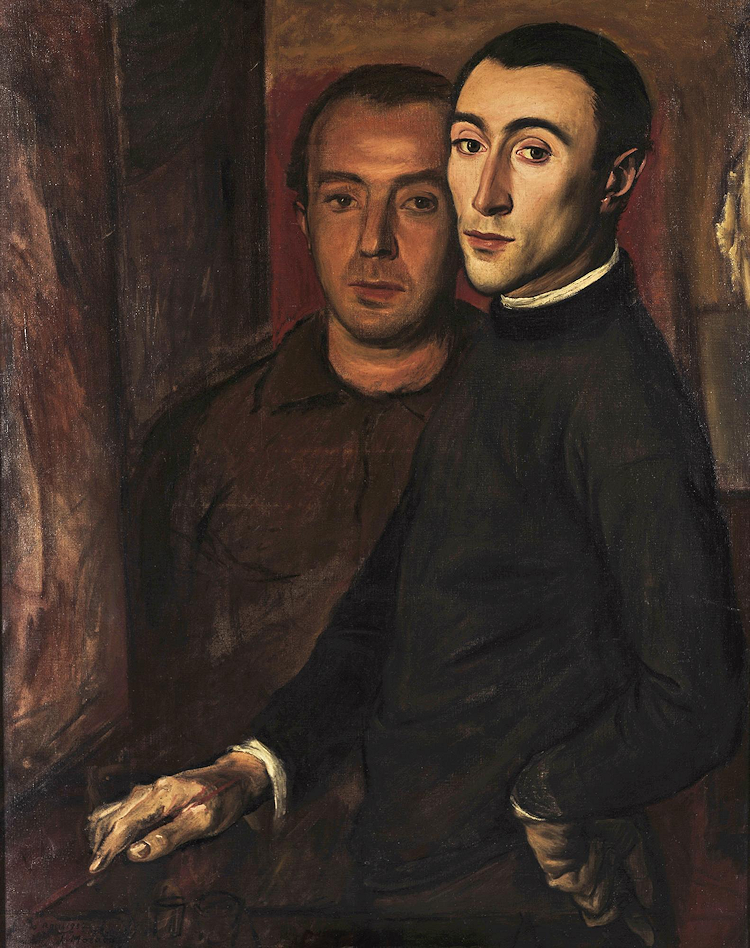
Self-portrait of the artist with Nikolaos Nikolaou, 1937.
M. D., 1943.
Composition with Mandolin, Books, and Apples, 1939.
Maria Roussen (the artist's first wife), 1943.
Pregnant Woman (the artist's second wife, Aglaia Lyberaki, pregnant with their son Konstantinos), 1948.
Sculptor John Pappas, 1938.
Still-life, 1939.
Nikolaos Louros, Professor of Obstetrics and Gynecology, 1949.
1951.
1950.
1955.
Still-life with Hats, 1939.
Self-portrait with the artist's first wife, 1943.
Still-life with Shoes, 1941.

*

Yiannis Moralis (Greek: Γιάννης Μόραλης; also transliterated Yannis Moralis or Giannis Moralis; 23 April 1916, Arta - 20 December 2009, Athens), Greek visual artist and part of the so-called "Generation of the Thirties". He moved with his parents to Athens when he was eleven, and from the age of fifteen he studied at the School of Fine Arts there. Five years later he received a grant from this school to study for a year in Rome. After this, he went to Paris to study fresco and mural work at the École Nationale Supérieure des Beaux-Arts in Paris. He also studied mosaic at the École des Arts et Métiers. When the Second World War broke out in 1939, he returned to Greece. The first exhibition of one of his works was in 1940; numerous other exhibitions followed both nationally and internationally. During the war, he focused on portraiture, ensuring a steady income. In 1941 he married Maria Roussen, but they divorced only four years later. In 1947 he married sculptor Aglaia Lyberaki; they had a son, Konstantinos, before, in 1955, they too divorced. From 1947 he taught at the Athens School of Fine Arts until his retirement in 1983. During this time he was also involved with creating set and costume designs for the Greek National Theatre and the Greek National Ballet; illustrating poetic works by Odysseas Elytis and Giorgos Seferis; and decorating architectural works such as the façade of the Athens Hilton, the Metro-Station "Panepistimiou", and the Athens Central Station. In 1965 he was decorated by King Constantine II with the Order of the Phoenix. From the 1970s, he moved away from the realistic depictions of the human form towards a geometric abstraction. He died in Athens at the age of ninety-three.


Friday, August 12, 2022

In the moment, captured - sketches by Carl Blechen

 
Augustanerbrücke bei Narni (Augustan bridge at Narni), 1829.
Bucht von Rapallo (Bay of Rapallo), circa 1829-30.
Weg durch einen Eichenwald (Path through an oak forest), ND.
Junge Eiche (Young oak tree), circa 1820s.
In der Campagna (In the Campagna), circa 1828-29.
Aus dem Apennin (From the Apennines), 1829.
Galgenberg bei Gewitterstimmung (A scaffold in a storm), circa 1835.
Landschaft mit Sonnenuntergang (Landscape with sunset), ND.
Im Park der Villa Borghese (In the park of the Villa Borghese), 1823.
Ein Brunnen in einem Park (A fountain in a park), 1831.
Mönch auf der Terrasse (Monk on the terrace), 1835.
Waldinneres mit Wanderer (Forest interior with hiker), ND.

*

And straying from "theme" because I find them so beautiful, two finished paintings:

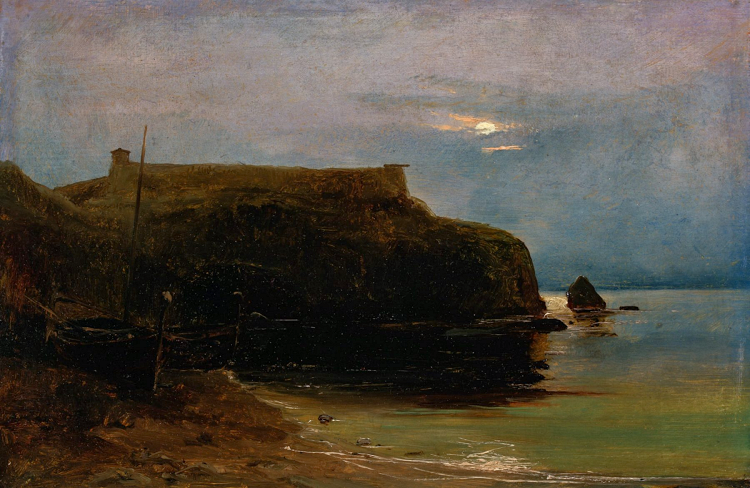
Fort bei Neapel (Fort near Naples), circa 1829.
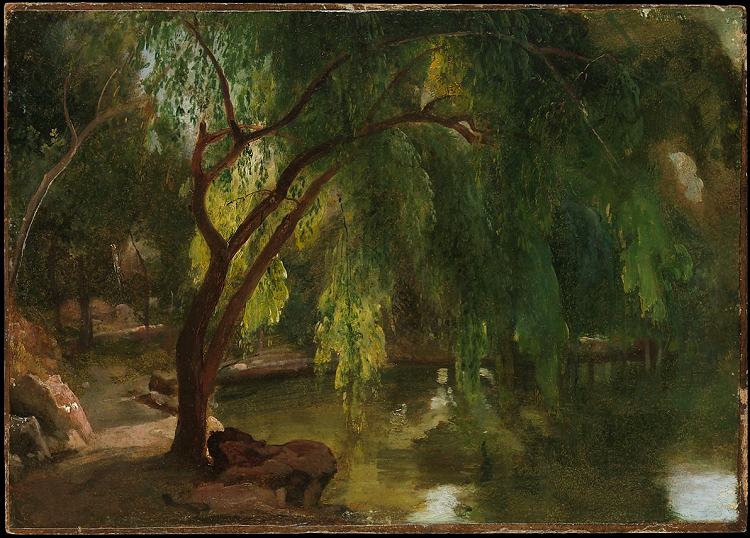
Im Berliner Tiergarten (In the Berlin Tiergarten), 1825.

*

Carl Eduard Ferdinand Blechen (29 July 1798, Cottbus – 23 July 1840, Berlin), German landscape painter and professor at the Academy of Arts, Berlin. His father was a minor tax official from Regensburg. His parents being unable to afford to pay for his education beyond the secondary level, they apprenticed him to a banker. He was engaged in that profession until he was twenty-four, when an increasing interest in art led him to the Berlin Academy. Not long after, he obtained a position as a decorator for the Royal Theater on the Alexanderplatz. He married in 1824 and became a member of the Berlin Artists' Association in 1827. Later that year, he was dismissed from the theater because of an ongoing dispute with a singer, after which he supported himself as a free-lance artist. In 1828, he took a study trip to the Baltic Sea, followed by a trip to Italy which produced hundreds of sketches that were later elaborated in his Berlin studio. In 1831, upon the recommendation of Karl Friedrich Schinkel, he was appointed Professor of Landscape Painting at the Berlin Academy. Four years later he became a full member of the Academy and took a study trip to Paris. It was then that the first symptoms of his mental illness appeared. His condition deteriorated and he suffered severe bouts of depression that forced him to take a leave of absence from the Academy in 1836. The following year, he had to be admitted to a hospital. He was able to make one final trip to Dresden, where he made his last drawings. He died four years later, in a state of complete mental collapse. Six days short of his forty-second birthday, he was buried in the Holy Trinity Cemetery (II); the exact location of his grave is lost, and he is only commemorated with a plaque on the cemetery wall.

Self-portrait, 1825.