L a - b e a u t é - s a u v e r a - l e - m o n d e ~ D o s t o ï e v s k i

L a - b e a u t é - s a u v e r a - l e - m o n d e  ~  D o s t o ï e v s k i


Showing posts with label François-Xavier Fabre. Show all posts

Sunday, November 19, 2023

Les dames du dix-huitième - selected portraits

 
Portrait presumed to be Miss Buchanan, English School, circa 1790.
Maria Fortunata d'Este, princesse de Conti, by Dominique Vivant Denon, circa 1780.
Unfinished portrait of Princess Sofia Albertina of Sweden, by Lorens Pasch the Younger, 1768.
Portrait of a lady said to be madame de Bellegarde, circle of Vigée Le Brun, Circa 1790.
Mrs. Paul Cobb Methuen, by Thomas Gainsborough, 1776-1777.
Portrait d'une dame de qualité, studio of Antoine Vestier, circa 1778.
Miss Theophila Offy Palmer, the future Mrs. Gwatkin, a portrait believed to be the work of Sir Joshua Reynolds’s sister, Frances Fanny Reynolds, circa 1770s.
The duchesse d'Aiguillon, by Adélaïde Labille-Guiard, 1790.
Mary Christina Conquest, Lady Arundell of Wardour, in coronation robes, by George Romney, circa 1770.
 Madame Sophie de France, daughter of Louis XV, by Jean-Étienne Liotard, circa 1750-51.
Maria Geronima Pellegrina "Lilla" Cambiaso and her daughter Caterina, by Anton Von Maron, 1792.
The depiction of the drapery is perfection, the detail of the two shoes, charming.
The artist's wife, by François-Xavier Fabre, circa 1790s.
The courtesan Kitty Fisher, by Nathaniel Hone, 1765.
The wonderful addition of the cat and fishbowl is a cheeky reference to the name of the sitter.
 Charlotte Herts, wife of Charles-François de Casteele, by Nicolas-Guy Brenet, 1770.
Portrait of a young woman, by Marie-Geneviève Navarre, 1774.


Friday, May 24, 2019

The scabbard as wardrobe - discretions of the "antique"


In contemporary and later depictions, ancient Greek warriors were most frequently portrayed as going into battle nearly or entirely nude. Which seems, for several reasons, rather... awkward? In later, slightly more prudish eras, all that male nudity could be problematic for artists whose intention was to depict one or more of the celebrated ancient heroes. One device employed to avoid so much full-frontal "military splendor" can often be found in French paintings of the Neoclassical period: a warrior's scabbard proved convenient for obscuring his most masculine attributes. This worked well enough while the subject - Achilles, Castor and Pollux, Leonidas, etc. - struck a beautifully static "antique" pose, but we might imagine that any sort of real-life movement - say, walking? - would be rather uncomfortable thus encumbered.

Achille donne à Nestor le prix de la sagesse, by Joseph-Désiré Court, 1820.
Hélène délivrée par Castor et Pollux, by Jean-Bruno Gassies, 1817.
Léonidas aux Thermopyles, by Jacques-Louis David, 1814.
Guerrier avec épée tirée, by Jean-Eugène-Charles Alberti, 1808.
Briséis pleurant Patrocle, by Léon Cogniet, 1815.
Hélène délivrée par Castor et Pollux, by Amable-Paul Coutan, circa 1820s.
Thésée vainqueur du Minotaure, by François-Joseph Heim, 1807.
Egisthe croyant découvrir le corps d'Oreste mort, découvre celui de Clytemnestre, by Auguste-Hyacinthe Debay, 1823.
Soldat romain au repos, académie, by François-Xavier Fabre, 1788. In this case the covering is the attached sword belt, the baldric.
Antigone donnant la sépulture à Polynice, by Sébastien Norblin, 1825. Someone's arm also proves a useful aid to modesty.
Les Sabines / L'Intervention des Sabines / Les Sabines arrêtant le combat entre les Romains et les Sabins, by Jacques-Louis David, 1799.


Saturday, February 13, 2016

Narcissus is more than a flower


We've had a few sunny and warm days here in Portland; the rain and cold will soon return, but it's been lovely. It's also been lovely, of late, to see what our new/old yard has in store, what the Spring will be presenting us with. (I've always heard that when you've come into possession of a old yard you need to spend the first year doing little and waiting to see what comes popping out of the ground; I'm sure I won't have that much patience.) At this point there really isn't even the shadow of what one could call a garden - the whole place has been horribly neglected, for years by the look of it - and back and front and side yards are all a dreary, flat nothing. But Nature is remarkably persistent, and besides the crocus - not at all my favorite - all sorts of other things are presently peeping out. There are quite obvious signs of tulips and the fragile beginnings of what I really hope are peonies - which are among my favorites. The most prevalent of the new re-arrivals are unmistakably daffodils and/or narcissus (I can't yet tell which)... which leads us - with the most tenuous thematic connection - to this post. To mark the beginnings of Spring, here are a just few examples inspired by that most fertile mythological ground for painters, the sad and instructive story of Narcissus. So, with your indulgence, I offer you a small, scantily-clad bouquet of narcissi!

Echo and Narcissus, by John William Waterhouse, 1903.
Narcissus Gazing at His Reflection, by Dirck van Baburen, circa 1621-22.
Narcissus, by Gyula Benczúr, 1881.
Narcissus, by Joseph Denis Odevaere, circa 1820.
The Death of Narcissus, by François-Xavier Fabre, 1814.
Narcissus, by Franciscus de Neve (II), after circa 1650.
Narcissus, by Franc Kavčič (known, variously, as Franz Caucig, Franco Caucig, Francesco Caucig, or Frančišek Caucig), before 1810.
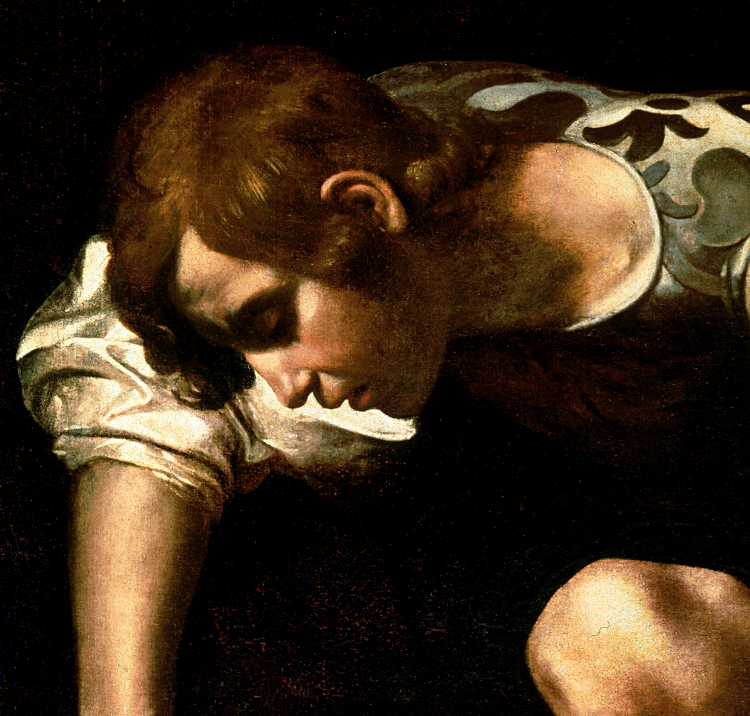
Narcissus, by Caravaggio, circa 1597-99.