|
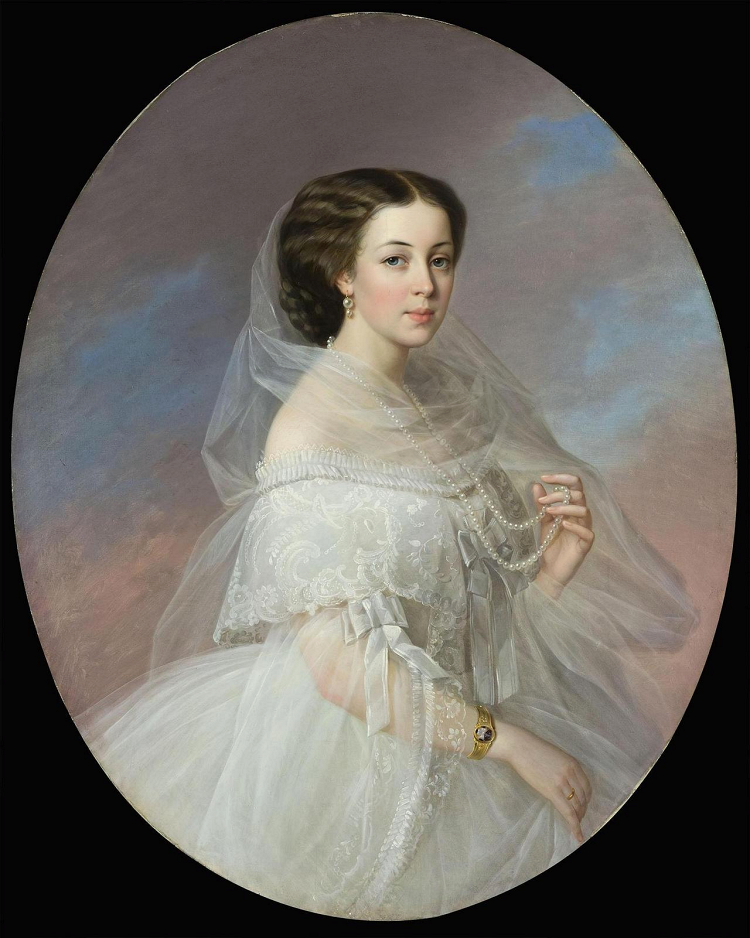
| The internet dates this portrait to 1917. I wonder. Seems odd that a British-born German would take the time to pose right in the middle of World War I. |
Daisy, Princess of Pless (Mary Theresa Olivia; née Cornwallis-West; 28 June 1873, Denbighshire, Wales - 29 June 1943,Waldenburg, Silesia - today Wałbrzych, Poland), noted society beauty of the Edwardian period and, by marriage, a member of one of Europe's wealthiest noble families. At eighteen she married Hans Heinrich XV, Prince of Pless, Count of Hochberg, Baron of Fürstenstein (1861–1938), the owner of large estates and coal mines in Silesia. The couple had three sons. (A daughter, their first child, died at a month old.) Daisy was a fixture at both the British and German courts prior to World War I, known for her style and extravagant lifestyle and much written about by the international press. By the end of the war and the fall of the German Empire, though, the family was heavily in debt, much of their wealth squandered. Her husband having divorced her in 1922, Daisy went on to publish a series of rather indiscreet memoirs between 1929 and 1936. The books were quite popular, but she died in relative poverty at the age of sixty.
 |
| Partly obscured by her gauzy red wrap, the Princess is wearing a gold-colored Fortuny Delphos. |
*
Both her birth family, the Cornwallis-Wests, and the family she made with the Prince of Pless were known for their "marital irregularities." Her brother George Cornwallis-West married Jennie Churchill, the mother of Winston Churchill, as her second - twenty years her junior - husband, and only five days after their divorce in 1914, he married the actress Mrs. Patrick Campbell. Daisy's sister, Constance, married Hugh Grosvenor, 2nd Duke of Westminster, and a month after their divorce in 1919 - it was very amicable and he provided a record-setting alimony - she married her considerably younger private secretary and agent, James FitzPatrick Lewes.
Three years after divorcing Daisy, Hans Heinrich married a Spanish noblewoman and had two more children. The marriage was annulled in 1934 after it was discovered that Daisy and Hans Heinrich's youngest son, Bolko, had been seduced by his step-mother. Bolko and his ex-step-mother went on to marry that same year and had two children together - Daisy and Hans Heinrich's only grandchildren, as it turned out - but Bolko died only two months after the birth of his namesake son; he was just twenty-five.
*
And then the marriage that didn't happen. In the summer of 1929, Daisy and the Dowager Queen Marie of Romania, friends in the pre-war days, became reacquainted after Marie received a copy of Daisy's newly published memoirs. Marie invited Daisy to visit and the latter took her middle son, Alexander - "Lexel" - with her. There, Lexel met Queen Marie's youngest daughter, Ileana, and the two promptly fell in love and were soon secretly engaged. Both mothers were happily supportive of the idea. But news of the engagement had gotten out, and the Romanian public and press felt differently, not thinking that the middle son of a minor German prince good enough for their popular young princess. Plans for the wedding were already underway, when the government intervened and instigated an investigation into Lexel's personal life. Quickly enough it was discovered that he'd been at the center of a homosexual scandal. It seems that he'd had relationships with several other young men. This had become known, and criminal charges had been brought. But the chief witness against him committed suicide in prison, and Lexel had been acquitted. Daisy tried to pass this all off as no more than a "boyish prank", but this was news the Queen of Romania couldn't ignore, and so she took her daughter and left the country, taking the royal yacht for a cruise to Egypt. The Romanian press had a field day when the reason for the rupture leaked out. Even so, both Lexel and Ileana made statements to the press that the wedding was still on. But soon enough, under pressure from the Romanian Foreign Office, came the statement from Lexel that he had "consented" to the breaking of the engagement.
Princess Ileana married Archduke Anton of Austria-Tuscany the following year. They had six children, were exiled more than once, and divorced in 1954. The next month, she married again - and divorced again eleven years later. In the meantime, she'd become an Orthodox nun and later founded her own monastery in Pennsylvania. She died at the age of eighty-two. Lexel never married. He served "with distinction" in Italy and North Africa during the Second World War. He appears to have enjoyed a fairly active gay lifestyle and died on Majorca at the age of seventy-nine.