L a - b e a u t é - s a u v e r a - l e - m o n d e ~ D o s t o ï e v s k i

L a - b e a u t é - s a u v e r a - l e - m o n d e  ~  D o s t o ï e v s k i


Showing posts with label Jacques-Henri Sablet. Show all posts

Sunday, July 9, 2023

Portraits des dames - a selection of females, painted

 
Emilie Henriette Massmann, the fiancée of Frederik Wilhelm Caspar von Benzon, by Christoffer Wilhelm Eckersberg, 1820.
Susanna van Meckema, Dutch School, circa 1600-25.
The Kavos sisters, by Alexander Mikhailovich Lyubimov, 1906.
Joséphine Baker, by Jean-Gabriel Domergue, circa 1936.
Unknown sitter, Cuzco School, circa 1780s-90s.
Kopfstudie, by Franz Wiegele, 1919.
Dame einen Papagei fütternd, by Anna Rosina de Gasc, née Lisiewska, 1747.
Unknown sitter, Circle of Jacques-Henri Sablet, circa 1800.
Princess Louisa Maria Stuart, by François de Troy, 1705.
Elizabeth Jane Gardner, by William-Adolphe Bouguereau (her husband), 1879.
Unknown sitter, by Thomas Desangle, 1785.
 Ludwika Karolina Radziwiłł, Margravine of Brandenburg and Electress Countess Palatine of Neuberg, Polish School, 1681.
Miss Jane Woode, British School, circa 1750.
Le Turban Vert, by Tamara de Lempicka, 1929.
Isabelle Depestre, comtesse de Seneffe, by Antoine Vestier, circa 1785.
Hermine Gallia, by Gustav Klimt, 1903-04.


Sunday, July 2, 2017

Lucien Bonaparte and Christine Boyer, his wife - three portraits by Jacques-Henri Sablet


Portrait de Lucien Bonaparte à Aranjuez. If the title is correct - I do wonder - this would have been painted during his time in Spain, circa 1801.

Lucien Bonaparte, 1st Prince of Canino and Musignano (born Luciano Buonaparte; 21 May 1775, Ajaccio - 29 June 1840, Viterbo), next younger bother of Napoléon. Born on Corsica and educated in France, he was much more genuinely radical than his famous brother. And though still in his teens, he became well-known and influential during the Revolution, an ally of Robespierre, his rise owing nothing to family connections. In the midst of the Reign of Terror, in May of 1794, he married his landlord's daughter, Christine Boyer (3 July 1771, Saint-Maximin-la-Sainte-Baume - 14 May 1800, Paris). Apparently illiterate, in the six short years of their marriage, she had four children, two of whom survived to adulthood, before dying at the age of twenty-eight. (Three years later he married a banker's widow and had ten more children.) With his great vigor, audacity, and with a convenient lack of scruples, Lucien had been instrumental in his brother's rise to power, but not long after Napoléon became First Consul in 1799, the relationship between the brothers first became strained. Six months after the death of his first wife, he was sent as ambassador to Spain, but on his return to France he was increasingly at odds with his brother's politics. And in 1804, unhappy with Napoléon's intention to declare himself Emperor, and with his demands that Lucien divorce his second wife in order to make a dynastic marriage, he went into self-imposed exile, living initially in Rome. After the Papal States were invaded by France in 1808, Lucien and his family were virtual prisoners. Attempting to escape to the United States two years later, they were captured by the British and spent the remainder of the Empire comfortably in England. Believing Lucien a traitor - France and England were at war - the Emperor struck his name from the Imperial lists. But when Napoléon escaped from Elba, Lucien rallied to his side and stood with him during the brief return to power. He returned to Italy at the Restoration and, after more than two decades indulging his love of archeology and other artistic endeavors, he died there at the age of sixty-five.  

Exhibited at the Salon of 1799, this portrait shows Christine Boyer with a bust of her daughter Victoire who was born and died two years before.
Lucien Bonaparte au château de Plessis–Chamant. Christine Boyer was buried there. He was apparently devastated by her death; he retired to
the château, and his mourning was so protracted that his brother, Napoléon, eventually had to intervene. This portrait is a sort of memento of
the marriage. I don't know when this was painted. But he looks older here than in the first image, so it seems it would have to be after 1801
but before his remarriage and the artist's death, both of which occurred in 1803.
Sablet has copied the entire portrait of Christine Boyer from the earlier painting.


Sunday, February 12, 2017

Élégie romaine - Roman Elegy - by Jacques-Henri Sablet, 1791


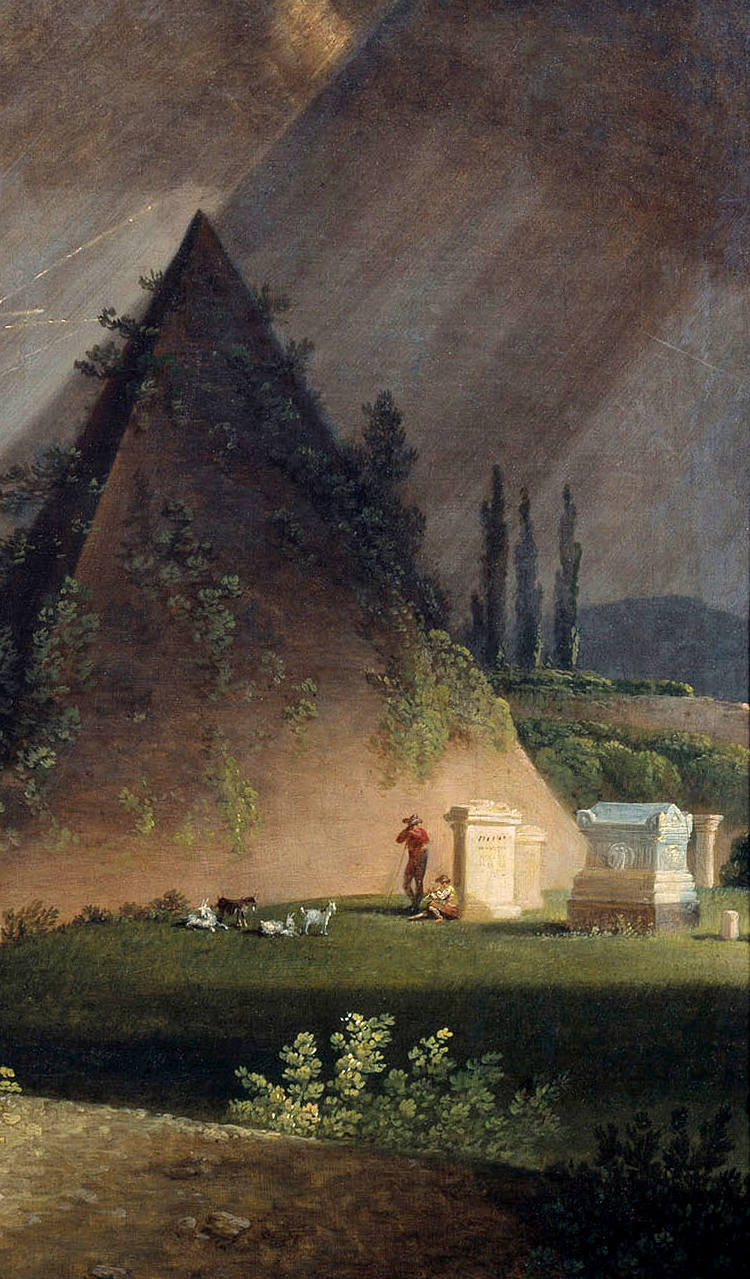
In the Protestant cemetery near the pyramid of Gaius Cestius in Rome, two unidentified men - dignified, elegant, soberly dressed in black - pose beside a neoclassical stele. The freshness of the stone's surface and the presence of the two white cloths suggest that the monument has just been cleaned or, conversely, that the carving has only recently been finished. In the background, two shepherds guard their grazing herds in the midst of the ancient tombs and ruins. This quiet and even melancholy painting is an example of  a "conversation piece", a genre long established in Great Britain which the Swiss-born, Paris-trained Sablet helped to popularize in France, where is was known as a "portrait de conversation". This double portrait can also be seen as a souvenir of the Grand Tour.  

In 1791, when this was painted, Sablet had been in Italy for sixteen years. He returned to Paris, along with a pension and artist's lodgings in the Louvre, three years later; the Terror had waned, but the flood of unrest instigated by the French Revolution had by then spread to the Apennine Peninsula.


Friday, December 20, 2013

Letizia Bonaparte dans son palais avec un domestique vêtu à l'orientale by Jacques Sablet


Letizia Buonaparte (August 24, 1750, Ajaccio – February 2, 1836, Rome), born Marie-Lætitia Ramolino, under the Empire called Madame Mère de l'Empereur or, simply, Madame Mère, was the mother of Napoléon I of France.  Married at thirteen, she bore that same number of children.  Of the eight who survived infancy, most would eventually wear a crown - at least temporarily - by the grace of their illustrious brother.  A famously tough old lady, she outlived the Empire, her son the emperor, and two of her daughters, living to the age of eighty-five.

Note the bust of her celebrated second son in the corner.

***

Jacques-Henri Sablet, né Jacob Henry Sablet (28 January 1749, Morges – 4 April 1803, Paris), Swiss painter.  The son of a decorative artist and gilder, he moved to Paris in 1772 to further his education. After studying with Joseph-Marie Vien for three years, he accompanied his master to Italy; he would remain in Italy for the next two decades. He had had ambitions of being a history painter, but eventually turned to portraiture, genre, and landscape painting. His elder brother François was also an artist.