

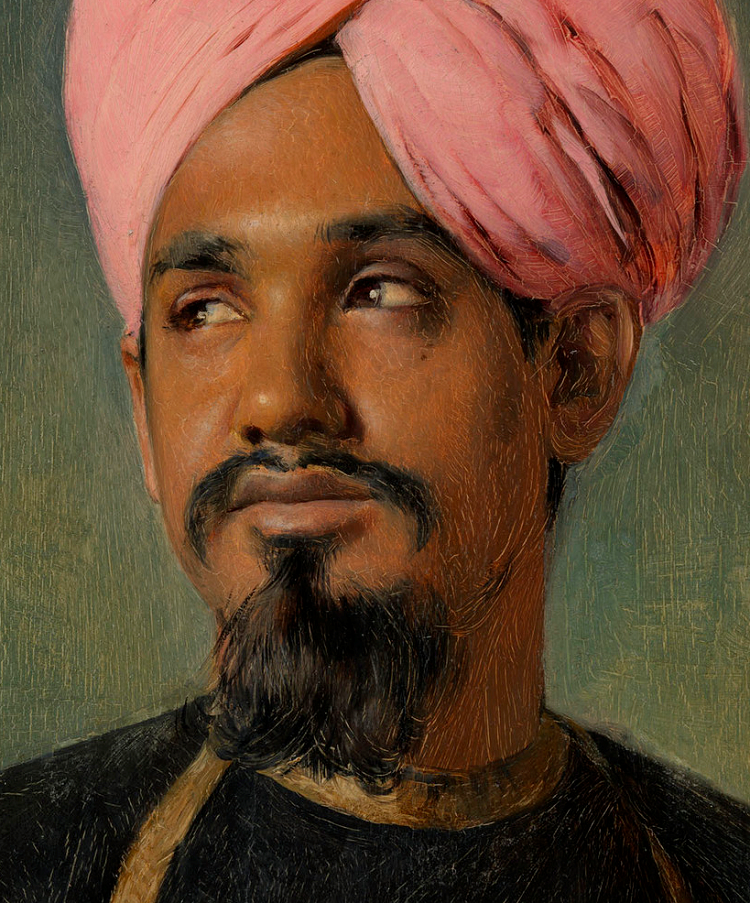
Rudolf Swoboda (4 October 1859, Vienna - 24 January 1914, Vienna), Austrian painter. He studied under his uncle, Leopold Carl Müller, and it was from Müller that Swoboda developed an interest in Orientalist art. In 1886, Queen Victoria commissioned Swoboda to paint several of a group of Indian artisans who had been brought to Windsor as part of the Golden Jubilee preparations. The Queen liked the resulting paintings so much that she paid for Swoboda's passage to India in order to paint more of her Indian subjects and gave him £300 to cover his traveling expenses. In return he was to provide the Queen with sketches worth £300. The artist had specific instructions: "The Sketches Her Majesty wishes to have – are of the various types of the different nationalities. They should consist of heads of the same size as those already done for The Queen, and also small full lengths, as well as sketches of landscapes, buildings, and other scenes. Her Majesty does not want any large pictures done at first, but thinks that perhaps you could bring away material for making them should they eventually be wished for." When Queen Victoria received the paintings she was very pleased and thought them, "such lovely heads… beautiful things." Swoboda would go on to work for the Queen for eleven years, producing more than forty portraits of South Asian subjects which are, today, kept at Osborne House.
 |
| Risaldar-Major Ali Muhammad Khan, 2nd Bengal Lancers. |
 |
| Warseli. |
 |
| Sha'ban. |
 |
| Ghulam Muhammad Khan. |
 |
| Sher Muhammad. |
 |
| Ramlal. |

 |
| Risaldar-Major Hukam Singh, Sirdar Bahadur, 16th Bengal Cavalry. |
 |
| Sappi. |
 |
| Jemadar Abdul Karim Khan, the Viceroy's Bodyguard. |
 |
| Bulbir Gurung. |
 |
| Saiyad Ahmad Hussain. (See also below, second to last painting.) |
 |
| Ghulum Mustafa. |
 |
| Muhammad Bey, Subadar, Bahadur, 1st Madras Lancers. |
 |
| Dorsaywala Gordenji. (And, no, I don't know what the numbered slip of paper signifies....) |
 |
| Sheikh Chidda. |
 |
| Risaldar Nadir Khan, 9th Bengal Lancers. |
 |
| Sikander Mallik. |
 |
| Sunder Singh. |
 |
| Saiyad Hurmat Ali. |
 |
| Bhai Ram Singh. |
 |
| Sarup Singh. |
 |
| Saiyad Ahmad Hussain. (See full-length portrait above.) |
 |
| Maulvie Raffindin Ahmad. |


