L a - b e a u t é - s a u v e r a - l e - m o n d e ~ D o s t o ï e v s k i

L a - b e a u t é - s a u v e r a - l e - m o n d e  ~  D o s t o ï e v s k i


Showing posts with label Johnny Weissmuller. Show all posts

Friday, June 7, 2024

Lou of the Jungle - Lou Gehrig auditions for Tarzan, 1936


The history of the screen career of Edgar Rice Burroughs' Tarzan character is a long and complicated one. His first big screen appearance came in 1918, his most recent 2016. From 1932 to 1936, MGM made three very successful Tarzan films starring Johnny Weissmuller. But then MGM seems to have lost control of the film rights while, in the meantime, Burroughs had sold independent producer Sol Lesser options on his Tarzan novels for films to be produced at 20th Century Fox. Under contract to MGM, Weissmuller was unavailable to continue in the role, so a search began for a replacement, and athletes - like the former Olympic swimmer - were the most likely candidates.


At the instigation of his wife Eleanor - who was said to have had a “vision” for her husband’s career - Gehrig had previously signed on with Babe Ruth’s aggressive agent, Christy Walsh. When the Tarzan role looked up for grabs, Walsh pushed Gehrig to campaign for it. And when the agent suggested the baseball player to Lesser, the producer was receptive to the idea but, considering the character's necessary state of undress, he wanted to have a better idea of what Gehrig looked like out of uniform.


Walsh had the usually rather dignified Gehrig photographed in a leopard skin costume and, not satisfied with sending them to Lesser, also circulated the images to the media, probably hoping to create a public groundswell for Gehrig taking the part. Not surprisingly, the photographs were met with derision. Author Burroughs even snidely telegrammed Gehrig directly, “Having seen several pictures of you as Tarzan and having paid about $50 for newspaper clippings on the subject, I want to congratulate you on being a swell first baseman.”
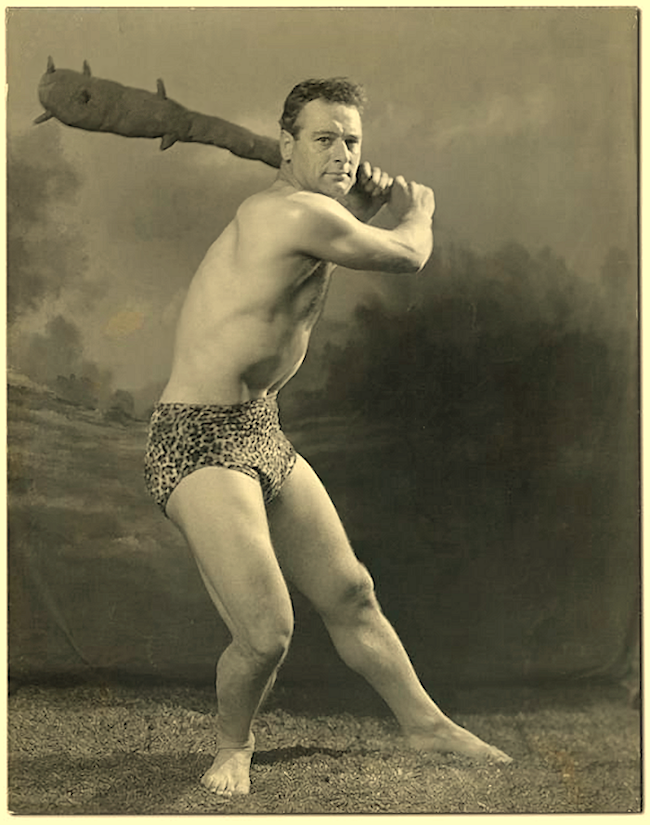

After viewing the photographs himself, and finding Gehrig’s massive legs “more functional than decorative,” Lesser ruled him out for the role. The producer went on to choose gold medal decathlete Glenn Morris for his new Tarzan. The resulting film, 1938's Tarzan's Revenge, proved to be a flop and Lesser sold the rights back to MGM, where Tarzan and Weissmuller reunited for three more films. Then, Tarzan, Weissmuller, and Lesser all decamped to RKO for a further six films; Lesser would go on to produce nine more Tarzan films after Weissmuller's departure.

*

These three images go a good way toward explaining why he didn't get the part.

The "Iron Horse" certainly had the brawn...


... But it was probably better utilized wielding a bat.


Sunday, October 7, 2018

Becoming Tarzan - youthful images of Johnny Weissmuller


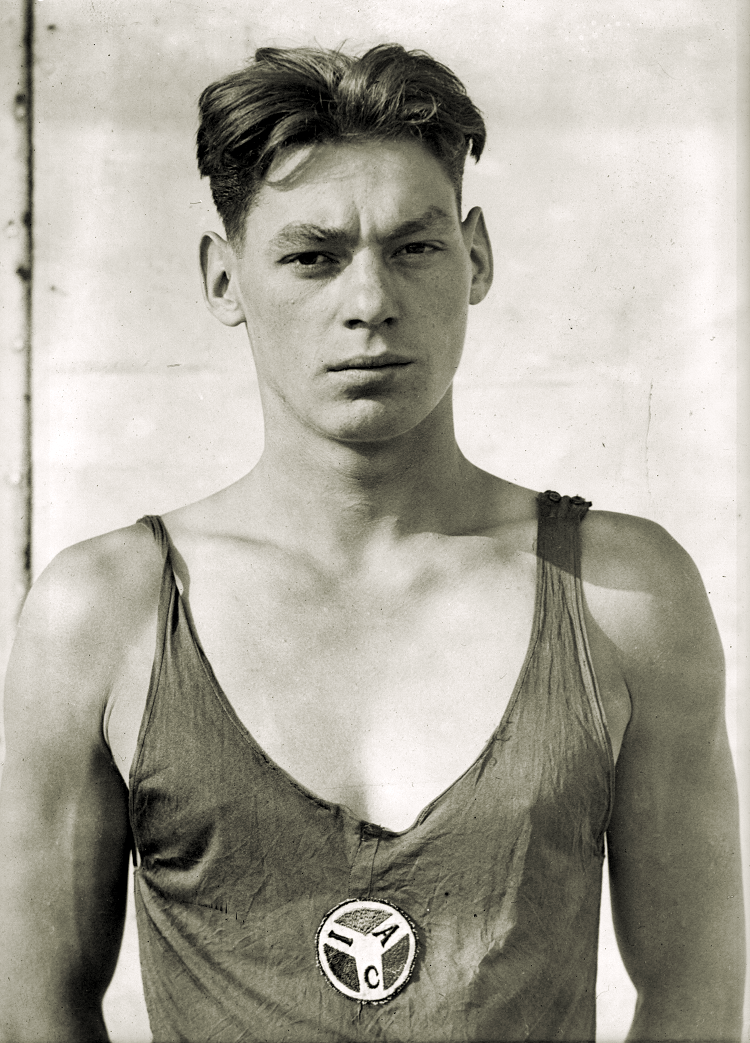
I've never been particularly interested in Johnny Weissmuller or his career as Tarzan. Nor was I ever impressed, as others have been, by his physique; I thought he looked somehow a bit slack. But he was certainly considered an Adonis in his day, the very model of male perfection. So I was surprised, when I recently came across very early pictures of him, taken a decade before the Tarzan train started, and saw how scrawny he looked, how un-Olympian. His career as one of the most important swimmers of the twentieth century had already quite successfully begun, and he was already breaking records; he broke the world record in the 100-meter freestyle when he was only eighteen. So I found it very interesting to see how much he changed physically during the decade from eighteen to twenty-eight, when he was cast as Tarzan.

Wearing the Illinois Athletic Club insignia, 1922. (Three images.)

Johnny Weissmuller (2 June 1904, Szabadfalva/Freidorf, Austria-Hungary, now Timișoara, Romania – 20 January 1984, Acapulco, Mexico), Austro-Hungarian-born American competitive swimmer and actor. Born Johann Weißmüller, he was seven months old when his parents arrived at Ellis Island; the family settled first in Pennsylvania and then Chicago. At the age of nine, he contracted polio and, at the suggestion of his doctor, he took up swimming to help battle the disease. He continued swimming and eventually earned a spot on the YMCA swim team. He dropped out of high school to work various jobs including a stint as a lifeguard at a Lake Michigan beach. While working as an elevator operator and bellboy at the Illinois Athletic Club, he caught the eye of famous swim coach William Bachrach; in August 1921, Weissmuller won the national championships in the 50-yard and 220-yard distances, and the following year he broke Duke Kahanamoku's world record in the 100-meter freestyle.

Circa 1924. (Three images.)

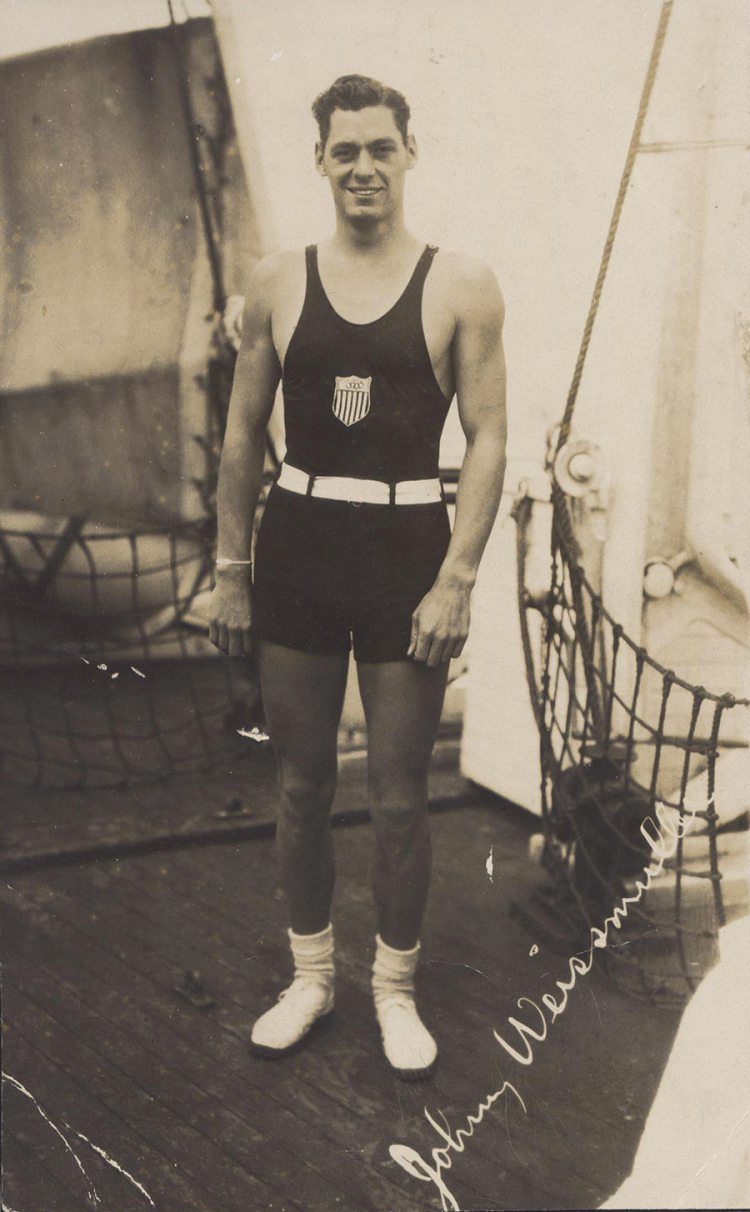
At the 1924 Summer Olympics in Paris he went on to win gold medals in the 100- and 400-meter freestyle, and was a member of the winning U.S. team in the 4×200-meter relay. As a member of the U.S. water polo team, he also won a bronze medal. In 1928, at the Summer Olympics in Amsterdam, he won two more gold medals, for the 100-meter freestyle, and as a member of the team in the 4×200-meter relay. In the summer of 1929, because of his now international celebrity, he was chosen to officially open the Piscine Molitor in Paris. That same year, he signed a contract with BVD to be the face - and figure - of the company, touring the country as their representative. He made cameo appearances in a few movie shorts, and in 1932 signed a seven year contract with MGM.

Shipboard, circa 1928.
At the Piscine Molitor, Paris, circa 1929.
Two portraits by George Hoyningen-Huene, taken at the Piscine Molitor, Paris, circa 1929-30.

"Tarzan the Ape Man" was a huge success, and Weissmuller made a total of six Tarzan films for the studio, before moving to RKO where he made another six, though with markedly reduced production values. After that, he moved to Columbia, where he made thirteen Jungle Jim features between 1948 and 1954. He then took Jungle Jim to television for twenty-seven episodes beginning in 1956. He was involved in numerous business ventures, but spent a lot of time golfing and at his home in Mexico. He only had small roles in three more films, and after several years of ill health, including a series of strokes, he died at his adopted home of Acapulco at the age of seventy-nine. At his request, a recording of his famous Tarzan yell was played as his coffin was lowered into the ground.

In connection with his work for BVD, Weissmuller poses for artist John Hubbard Rich (?), circa 1929.
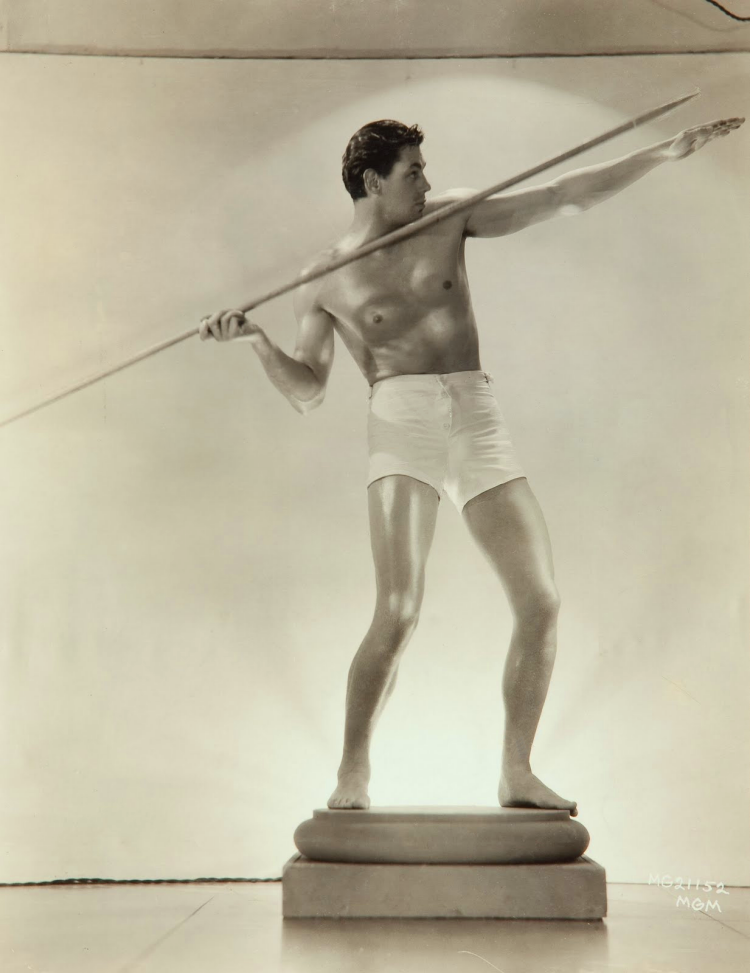
Two photographs by George Hurrell, taken in connection with the Summer Olympics in Los Angeles, 1932 - games in which Weissmuller did not compete.

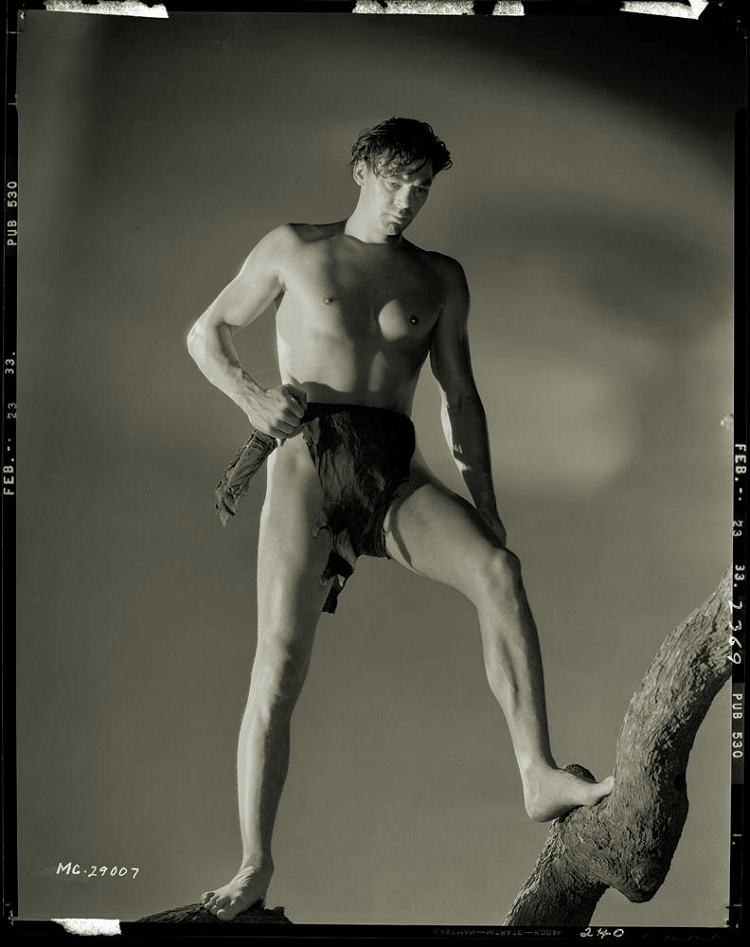
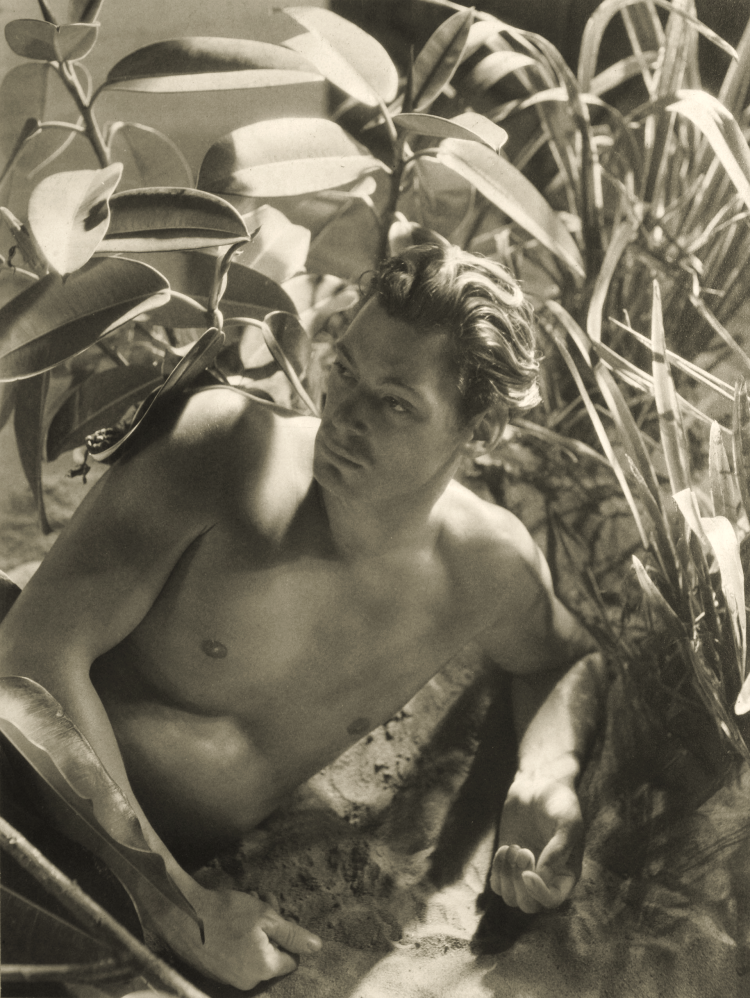
And to prove myself quite foolish in questioning his physical charms, here are portraits of Weissmuller from 1932 and 1933, newly Tarzan.

Photographs to publicize Tarzan the Ape Man by George Hurrell, 1932. (Seven images.)
Photographs by Harvey White, 1933. (Five images.)
Two portraits by Cecil Beaton, 1932.