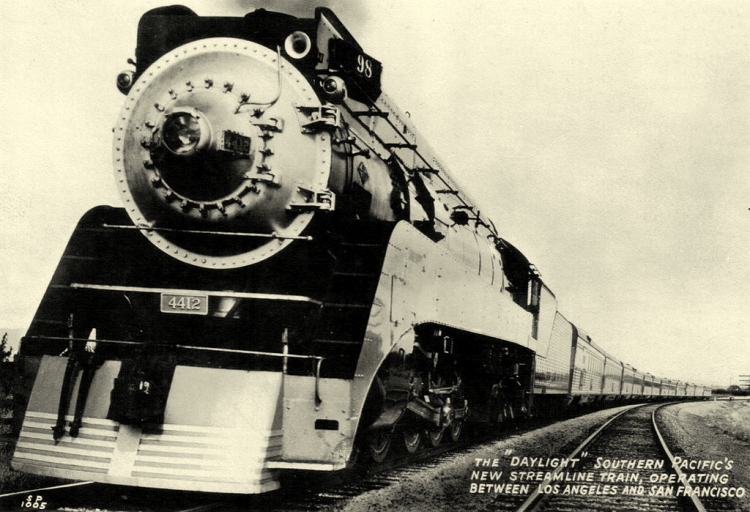
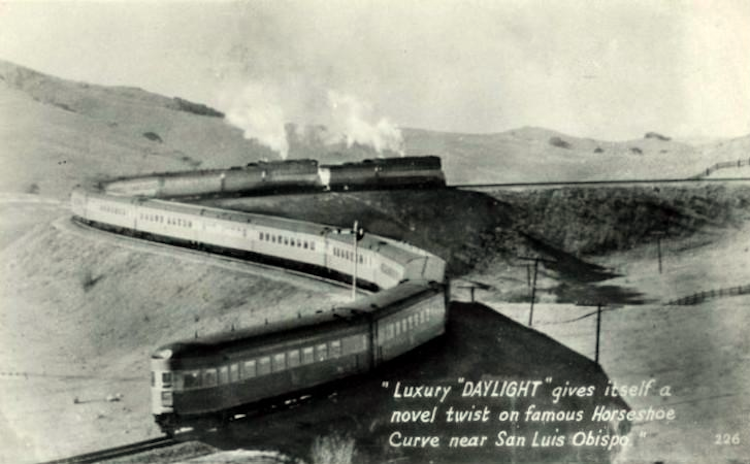
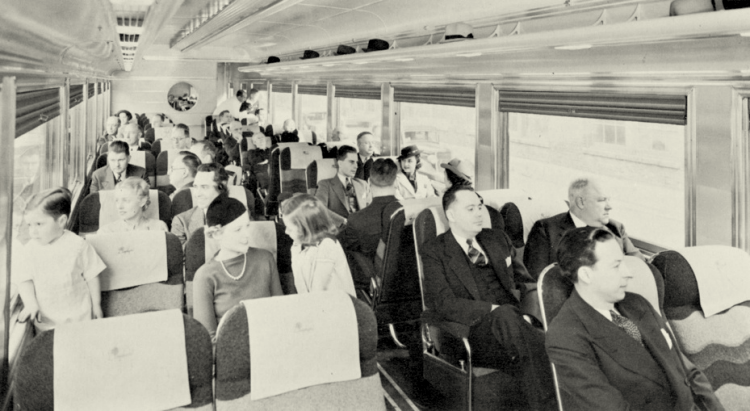
Adapted from Wikipedia. The Coast Daylight, originally known as the Daylight Limited, was a passenger train on the Southern Pacific Railroad between Los Angeles and San Francisco, California, via Southern Pacific's Coast Line. It was advertised as the "most beautiful passenger train in the world," carrying a particular red, orange, and black color scheme. The train operated from 1937 until 1974.
 |
| The parlor/observation car. (Three images.) |
 |
| The tavern car. (Two images.) |
 |
| The staff of the coffee shop car. |
Southern Pacific had introduced the Daylight Limited on 28 April 1922. The train operated on a thirteen hour schedule between the Third and Townsend Depot in San Francisco and Central Station in Los Angeles, running on Fridays and Saturdays only. In 1922 and 1923 the train ran seasonally, beginning in April and ending in November. Daily operation began in July 1923. Southern Pacific shortened the running time to twelve hours for the 1924 season. Until the late 1920s it made no intermediate stops other than for servicing, making it the longest nonstop run in the world at that time. Its twelve hour schedule was two hours better than any other train on its route.
The new streamlined Daylight began service on 21 March 1937, pulled by GS-2 steam locomotives on a nine and three-quarters hour schedule. It was the first of the Daylight series that later included the San Joaquin Daylight, Shasta Daylight, Sacramento Daylight, and Sunbeam.
 |
| The Los Angeles ticket counter. |
 |
| The coffee shop car. (Two images.) |
 |
| The coffee shop car menu., circa 1940s. |
By 30 June 1939, the streamlined Daylights had carried 268.6 million passenger miles on 781,141 train miles for an average occupancy of 344 passengers. A second train, the Noon Daylight, ran the same route 1940-42 and, after a suspension during World War II, 1946-49. The original Coast Daylight became the Morning Daylight during this time.
 |
| The tavern car. (Three images.) |
 |
| The original dining car menu. (Two images.) |
 |
| Informational pamphlet, circa 1940s. (Two images.) |
 |
| Advertisement, circa 1940s. |
The Coast Daylight ran behind steam until 7 January 1955, long after most streamliners had been powered by diesel.
*
For a truly comprehensive history of the this train line - with amazing images - please visit this website: