L a - b e a u t é - s a u v e r a - l e - m o n d e ~ D o s t o ï e v s k i

L a - b e a u t é - s a u v e r a - l e - m o n d e  ~  D o s t o ï e v s k i


Wednesday, August 19, 2015

Rosalind Russell as Sylvia Fowler in publicity for "The Women", 1939


***

On the lot with Adrian, the designer of all the amazing costumes for "The Women".

***

As a bonus, here's another wacky costume designed for the film but, in this case, not used. Going by the equine theme of this toilette, I expect this was meant for one of the scenes played out at the ranch-as-lady's-club for incipient divorcées set in that fabled classic-film divorce locale, Reno.


Sunday, August 16, 2015

Irina on Corsica


Princess Irina Yusupova, only niece of the last tsar, and her husband, the notorious Prince Felix Yusupov, fared better than most after having fled revolutionary Russia in 1919. They hadn't a shadow of their former wealth, but they had a home in Paris and sufficient capital to afford them a quite comfortable lifestyle and allow them to be very generous with those emigrés who were less fortunate. They also had a rather ramshackle house at Calvi on the island of Corsica.* In her second memoir, "A Princess in Exile", Irina's cousin, Grand Duchess Maria Pavlovna, who visited with them there, describes it as a "ridiculous half-tumbledown building" and a "shack", and said that there was little to eat, no proper water supply, and "appalling" sanitary conditions. She also mentions that they all managed to have a very good time.

With an unidentified companion at left.
With her brother, Prince Feodor Alexandrovich.
With Feodor and two other gentlemen.
With an unidentified companion.

***

* Since I found most of these images uncaptioned, I can't promise that they were all taken on Corsica. In some cases I'm making an educated guess. At any rate, they were taken someplace warm and sunny and at least a bit rustic, someplace that decidedly isn't Paris.


Wednesday, August 12, 2015

John Jennings with his brother and his sister-in-law, by Alexander Roslin, 1769


John Jennings (at right) with his brother Francis (or Frans) and Francis' wife Jeanne, née Trembley.

John Jennings (3 December 1729, Stockholm - 14 December 1773, Forsmark), Swedish merchant and politician. The son of an Anglo/Irish iron merchant who had settled in Sweden, he continued in his father's trade, amassing wealth and great political influence. He had large reversals toward the end of the 1760s, though, and his business did not long survive his death at the age of forty-four.

I don't know the genesis of this group portrait; Jennings was married and had at least one child - his son inherited the business at Jennings' death - so why is he not posed with his wife and child (or children)? Roslin was a very fashionable painter - in other words, expensive - and it seems rather odd that a sitter would pose with his brother and sister-in-law for such an important commission. Jennings gestures toward Jeanne, Francis' wife, making her the apparent focus of the painting. I don't know what year the couple married; could this painting have been commissioned to mark that occasion? If so, the well-fed John Jennings would certainly seem a little de trop, plopped down in front, taking up more than a third of the canvas.

John Jennings, portrayed in what one would call a "speaking likeness".
As with all Roslin's work, the details are exquisite.
The truly extraordinary rendering of the lace and satin, especially the passages of the reflected red of Jennings' velvet breeches... perfection.

***

There is also a vignette of Jennings copied from the group portrait.
Almost certainly not by the hand of Roslin, the painting seems rather crude when compared with the original.


Sunday, August 9, 2015

The golden green of Italy - landscapes by Pierre-Athanase Chauvin


View of the Gardens of the Villa Falconieri, Frascati, 1810.
 View of the Gardens of the Villa d'Este, Tivoli, 1811.
View of the Abbey of Grottaferrata, circa 1811.
(Detail.)
(Detail.)
A Convent Near Naples with a View of Capri, 1816.
Italian Landscape, no date.
Another version of "A Convent Near Naples with a View of Capri", circa 1816.
Monks Before Lake Nemi, no date.
(Detail.)
(Detail.)

***

Pierre-Athanase Chauvin (9 June 1774, Paris - 29 October 1832, Rome), French painter, later resident in Italy. A student of the landscape painter Pierre-Henri de Valenciennes, he began his career at the Paris Salon of 1793. In 1813, Chauvin settled in Rome and became a member of the Accademia di San Luca, but maintained his connections with the Arts community in Paris; he won a First Class medal at the Salon of 1819, and was made a chevalier of the Légion d'honneur in 1828.


Wednesday, August 5, 2015

Prince Alexander Konstantinovich Gorchakov, by Nikolai Bogdanov-Belsky, 1904.


I've been unable to find very much on the life of this handsome Prince Gorchakov. Born on 17 September 1875 in Vaud, Switzerland, he was the third son of Prince Konstantin Alexandrovich Gorchakov - Russian ambassador to, variously, Switzerland, Saxony, and Spain - and Princess Maria Mikhailovna Sturdza. In 1904 - the year this portrait was painted - he married Daria Mikhailovna Bibikova (1883-1962), a lady-in-waiting to the Empress Alexandra Feodorovna. Fighting in World War I, he was seriously wounded at the front and died in a St. Petersburg hospital from his injuries on 18 March 1916 at the age of only forty. He was buried in the cemetery of the monastery of St. John of Kronstadt.


*

Nikolai Petrovich Bogdanov-Belsky (1868–1945), Russian painter whose work consists mainly of portraits, genre paintings, and landscapes. Born in the village of Shitiki in the Smolensk region, he studied art at the Semyon Rachinsky fine art school, icon-painting at the Troitse-Sergiyeva Lavra in 1883, modern painting at the Moscow School of Painting, Sculpture and Architecture from 1884 to 1889, and at the Imperial Academy of Arts in St. Petersburg from 1894 to 1895. He later worked with studios in Paris. Active in St. Petersburg, he was a member of several prominent societies and became pedagogue and academician in 1903; he was an active Member of the Academy of Arts. After 1921, he worked and lived exclusively in Riga, Latvia. He died at the end of World War II, in Berlin.

*

Also by Bogdanov-Belsky, and elsewhere labeled a portrait of the prince's wife, family descendants claim it portrays his sister, Elena, Princess Gorchakova, 1903.


Sunday, August 2, 2015

Serious English faces - portraits by John Greenhill


Thomas Herbert, 8th Earl of Pembroke, circa mid-1670s. (Detail.)

John Greenhill (circa 1644, Salisbury – 19 May 1676, London), English portrait painter. Interested in art from an early age, in about 1662 he moved to London in order to study. He became a pupil of Sir Peter Lely, and also carefully studied and copied the late van Dyck's portraits; it is said that his rapidly progressing skill aroused Lely's jealousy. He married early and was at first industrious and increasingly successful. But he had a pronounced taste for the theater and, living in Covent Garden, he began to associate with free-living theatrical types, and fell into "irregular habits". In May of 1676, while returning from a tavern in a drunken state, he fell into the gutter. Carried to his lodgings, he died the same night. He left a widow and family, to whom Lely gave an annuity. There's disagreement as to the date of his birth, but he was probably about thirty-two.

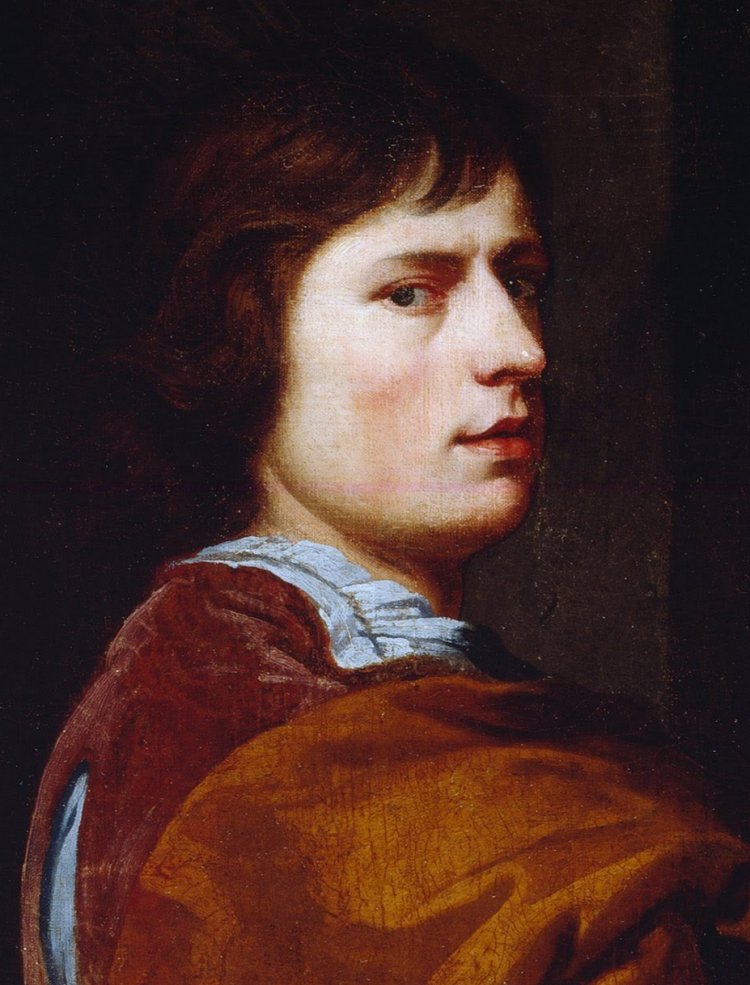
The artist, circa 1665.
Portrait of a lady, traditionally identified as Lucy Sherman, no date.
Thomas Weedon, circa 1675.
Sir Anthony Deane, no date.
Lady Twisden, 1676.
William Cartwright, circa mid-1660s.
 Sir Matthew Dudley, Bt (attributed to Greenhill), no date.
Portrait of a Lady as a Shepherdess, circa 1665.
James, Duke of York, later James II, early 1660s. (This portrait definitely appears to be unfinished.)
Anthony Ashley-Cooper, 1st Earl of Shaftesbury, circa 1672-73.
Mrs. Jane Cartwright, circa mid-1660s.
John Locke, circa 1672-76.