L a - b e a u t é - s a u v e r a - l e - m o n d e ~ D o s t o ï e v s k i

L a - b e a u t é - s a u v e r a - l e - m o n d e  ~  D o s t o ï e v s k i


Sunday, October 13, 2024

Random Hollywood

 
Carole Lombard, by George Hoyningen-Huene, 1934.
Groucho Marx and Marlene Dietrich, circa 1932-33.
Gloria Swanson, publicity for "Music in the Air", photograph by Otto Dyar, 1934.
Mary Astor and Peter Lorre on the set of "The Maltese Falcon", 1941.
Passport for Roy Harold Fitzgerald, aka Rock Hudson, stamped 1952 and 1954.
Joan Crawford and Joan Crawford, circa early 1940s.
 Boris Karloff, ND.
Lucille Ball and Desi Arnaz, circa 1943.
Irene Dunne, by Roman Freulich, 1932.
Cary Grant and Rosalind Russell at the Academy Awards ceremony, 1942. 
James Stewart and Judy Garland, circa 1941. (Spencer Tracy can be seen in the background, far right.)
Bette Davis, publicity for "The Letter", 1940.
Clark Gable and Vivien Leigh rehearsing during the production of "Gone With The Wind", 1939.
Norma Shearer chez elle, 1948.
Jean Harlow, by George Hurrell for Vanity Fair, 1935.
Dick Powell, publicity for "Murder, My Sweet', photograph by Ernest Bachrach, 1944.
Rosalind Russell, publicity for "The Velvet Touch", 1948.
Judy Garland, Mickey Rooney, and Shirley Temple, 1941.
Audrey Totter, by Clarence Sinclair Bull, 1944.
Passport for Katherine Hepburn, circa late 1930s. Note the exception to travel in Spain, which was in the midst of its Civil War.
Olivia de Havilland and Vivien Leigh (and stewardess?) en route to the Atlanta premiere of "Gone With the Wind", 1939.
Franchot Tone, Richard Cromwell, and Gary Cooper during the filming of "The Lives of a Bengal Lancer", 1934.
Dolores del Rio, publicity for "Madame Du Barry", 1934.
Joan Blondell and Bette Davis during the filming of "Three on a Match", 1932.
Adrienne Ames, circa early 1930s.
Freddie Bartholomew and Douglas Scott during the filming of "Lloyd's of London", 1936.
Kay Francis during the filming of "It's a Date", 1941. 
Mannequins who were featured in the "Lovely to Look At" fashion show in "Roberta", 1935.
Tallulah Bankhead and Dickie Moore, 1932.
Alice Faye, circa 1940.
Passport for Cary Grant, stamped 1946 and 1947.
Stars gathered at the Hollywood Bowl in 1943 to welcome Madame Chaing Kai-Shek who was on a tour of the United States. 
In the background at far left can be seen Ginger Rogers, Shirley Temple, and Barbara Stanwyck. While in the foreground, left to right
and front to back, are Ingrid Bergman, Marlene Dietrich, Irene Dunne, Rosalind Russell, Deanna Durbin, Kay Francis, and Loretta Young.
Lizabeth Scott and Raymond Burr, publicity for "Pitfall", 1948.
Montgomery Clift and Elizabeth Taylor during the filming of "A Place in the Sun", photograph by Peter Stackpole, 1950.
Claire Trevor, publicity for "Murder, My Sweet", 1944.
Marion Davies, publicity for "Going Hollywood", 1933.
Clark Gable and his 1932 Packard Twin Six 905 Coupe Roadster.
Constance Bennett and Greta Garbo, "Two-Faced Woman", 1941.


Friday, October 11, 2024

Rooms intimate and lofty, personal and public - two paintings by Johan Vilhelm Gertner

 
A bedroom in Bernstorff Palace near Copenhagen, circa 1845.

Built in the middle of the eighteenth century for Danish foreign minister Count Johann Hartwig Ernst von Bernstorff, by 1842 the building had fallen into neglect and was about to be demolished when King Christian VIII of Denmark purchased it and ordered a complete renovation. Gertner painted the king on several occasions, so one might assume that some degree of familiarity led to the artist being given the opportunity to portray such a private space.


*

Thorvaldsen's Studio in the Royal Academy of Fine Arts, Copenhagen, 1836.

The studio in question was that of the celebrated Danish neo-classical sculptor Bertel Thorvaldsen. He was considered one of the greatest sculptors of his time, regarded as the successor of Antonio Canova. Mainly resident in Italy - he maintained a large workshop in Rome - he made a final triumphant return to Denmark in 1838, only six years before his death at the age of seventy-three.


Sunday, October 6, 2024

Sehr gemütlich - A nobleman and his wife, with a servant stoking the fire, by Wenceslaus Wehrlin, 1769


Adapted from the Christie's website:

Wenceslas Wehrlin  - or Venceslao Verlin, as he was called in Italy - was a little-known but talented artist known to have died in Florence in 1780. He is generally believed to have been Viennese and born about 1740, though an inscription on the reverse of his self-portrait in the Uffizi, if correct, would indicate that he was born in Turin in 1725. Various members of his family certainly seem to have served at the court in Turin, and he is likely to have begun his career there before moving to Florence. 


It's more than probable that the male sitter in this work was an Austrian dignitary at the grand ducal court in Florence; the letter on his desk is addressed to the Emperor, including his further titles of Archduke of Austria and King of Bohemia: "A Sua Maestà L’Imper... Arcidu... Boem... a."


The portrait hanging above the mantelpiece in this lively scene is that of Joseph II, Holy Roman Emperor. The Emperor's brother and eventual successor Leopold was, as Grand Duke of Tuscany, Wehrlin's most important patron; a group portrait of the grand ducal family dated 1773 is in the Kunsthistorisches Museum, Vienna.


The painting was auctioned at Christie's in December of 2008.


Friday, October 4, 2024

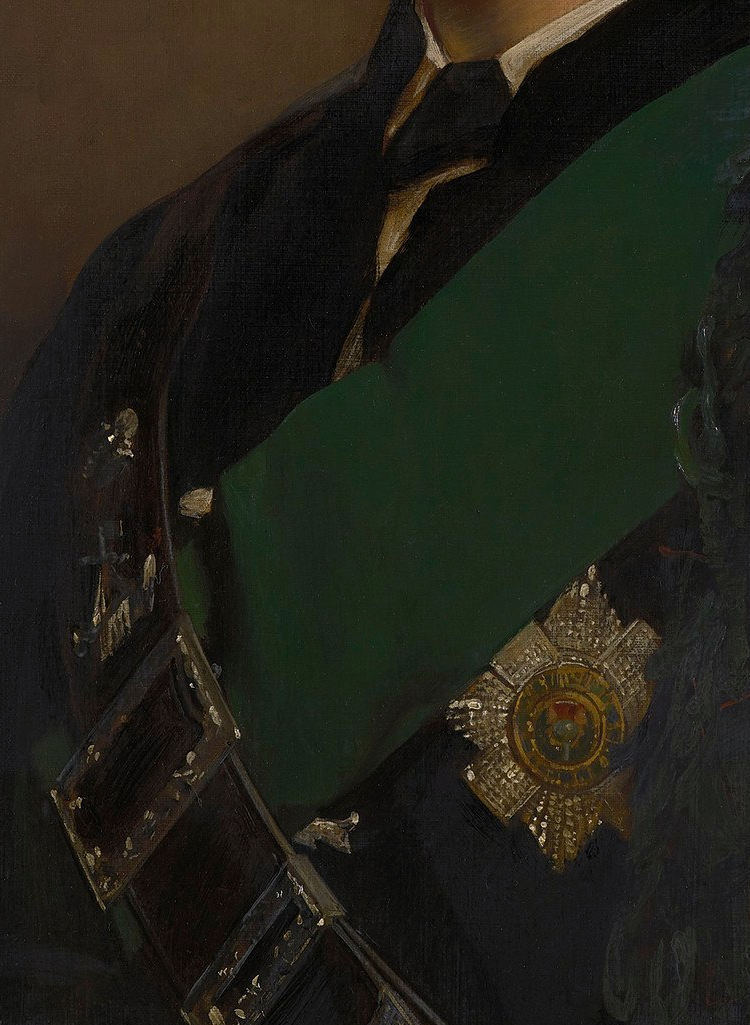
The Marquess and Marchioness of Lorne, by Heinrich von Angeli, 1875


In 1871, Princess Louise (Louisa Caroline Alberta; 18 March 1848, London - 3 December 1939. London), the sixth child and fourth daughter of Queen Victoria and Prince Albert, married John Campbell (John George Edward Henry Douglas Sutherland Campbell; 6 August 1845, London - 2 May 1914, Cowes), the Marquess of Lorne and, later, the 9th Duke of Argyll.


This was the first time since 1515 that a legitimate daughter of the sovereign had married a subject of the Crown. The pair shared a common love of the arts - Louise was a talented sculptor - but the marriage was childless and unhappy, and they spent much time apart. Lorne formed close friendships with men who were known to be homosexual or bisexual, and there has been conjecture that he may have been as well. Louise was an energetic supporter of the arts, higher education, and of the feminist cause.


*


Lorne was Governor General of Canada from 1878 to 1883, and the couple's tenure there was a success. On their return to England, Queen Victoria allocated them apartments in Kensington Palace where they would live for the remainder of their lives. Lorne succeeded to the title of Duke of Argyll in 1900. He suffered from dementia in his last years and Louise nursed him devotedly, the couple becoming closer than they had been before. Following his death in 1914 at the age of sixty-eight, Louise had a nervous breakdown, writing to a friend shortly afterwards: "My loneliness without the Duke is quite terrible. I wonder what he does now!" The Princess lived on for another twenty-five years, passing away at the age of ninety-one.

Lorne wears Highland dress in his portrait, along with the riband and star of the Order of the Thistle.

The portraits were commissioned by Queen Victoria who, on their delivery, was delighted with the results. She wrote to her eldest daughter, Victoria, Crown Princess of Prussia: "I have now got Louise's here and I own it is most exquisite. It is wonderfully, marvelously like, and there is a depth of feeling in the eye and mouth which are Louise herself and (as with all Angeli's pictures) you can look at it quite close by as though it were enamel - which is really what the surface is like…Lorne's is very good too and equally characteristic." 


*

Von Angeli was paid £150 for each of the portraits, the pair of which were placed in the Queen's drawing-room at Osborne House.


Sunday, September 29, 2024

A small memento - sapphire ring, Queen Victoria's coronation gift to one of her train bearers


This sapphire and diamond ring is engraved inside the band with Queen Victoria's cypher and the date of the Coronation in 1838, and was given to one of her eight train bearers who assisted her on that momentous occasion. It no longer seems to be recorded to whom the particular ring was originally given, but it was added to the royal collection by Queen Mary in 1925. And while I haven't found any mention of this on the Royal Collection's website, on the inside of the ring, behind the central sapphire, there appears to be something of a translucent "window"... and would that be, to make the gift that much more personal, a tiny bit of the queen's hair behind?

Queen Victoria Receiving the Sacrament at her Coronation, 28 June 1838, by Charles Robert Leslie, 1838-39.

Charles Robert Leslie's painting shows the Queen receiving the Sacrament towards the latter part of her Coronation. Queen Victoria's half-sister Feodora, Princess of Leiningen, wrote to the Queen later that year that the moment depicted in the painting "was the most touching of the whole ceremony, and one that is always before me; human greatness bowing before greatness above, I saw many eyes that were filled with tears; and I shall never forget that picture."


Queen Victoria was delighted with the painting too. She thought "the group of my youthful trainbearers is excessively pretty.". She wrote to Princess Feodora that it was "the loveliest picture of the coronation you can imagine; it is to be for me, and is a great deal smaller than Hayter's picture [see below] …. He has got me so like … and all the others, he has got so like, I am charmed with it'. It was praised by contemporaries and exhibited at the Royal Academy in 1843.

Queen Victoria described her train bearers in her Journal, as "all dressed alike and beautifully" in white satin and silver tissue, with pink roses in their hair.

*

Coronation of Queen Victoria in Westminster, Abbey 28 June 1838’, by Sir George Hayter, 1839-40.

Sir George Hayter's painting captures the moment in the coronation when, after the crowning, "the people with loud and repeated shouts, will cry 'GOD SAVE THE QUEEN': and immediately the Peers and Peeresses present will put on their Coronets" - in the queen's words, "a most beautiful and impressive moment." The queen is portrayed seated on the Coronation Chair, wearing the Imperial State Crown and holding in her right hand the Sceptre with the Cross and in her left the Sceptre with the Dove. 


Hayter was commissioned to record the scene less than a week before the coronation itself. The finished work depicts sixty-four of those participating or merely present during the ceremony, based on private sittings with the individuals in the two years following the event. The artist's family modelled the gowns and robes for him; his daughter Louisa modeled for the queen's hands.


*

The eight train bearers - who all seemed to find highly decorative - are nonetheless not terribly well represented in either of these coronation paintings. In Leslie's, only six appear - one almost entirely obscured - while in Hayter's a mere three make the cut.


*

The coronation day, from Queen Victoria's diary:

"I was awoke at four o'clock by the guns in the Park, and could not get much sleep afterwards on account of the noise of the people, bands, etc., etc. Got up at seven, feeling strong and well; the Park presented a curious spectacle, crowds of people up Constitution Hill, soldiers, Bands, etc.


"At ten I got into the State Coach with the Duchess of Sutherland and Lord Albemarle and we began our Progress. It was a fine day, and the crowds of people exceeded what I have ever seen; many as there were the day I went to the City, it was nothing, nothing to the multitudes, the millions of my loyal subjects, who were assembled in every spot to witness the Procession. Their good humour and excessive loyalty was beyond everything, and I really cannot say how proud I feel to be the Queen of such a Nation. I was alarmed at times for fear that the people would be crushed and squeezed on account of the tremendous rush and pressure.

Detail from a commemorative panorama - over 3 metres (almost ten feet) long - showing the procession within Westminster Abbey and identifying the key figures.

"I reached the Abbey amid deafening cheers at a little after half-past eleven; I first went into a robing-room quite close to the entrance where I found my eight train-bearers: Lady Caroline Lennox, Lady Adelaide Paget, Lady Mary Talbot, Lady Fanny Cowper, Lady Wilhelmina Stanhope, Lady Anne Fitzwilliam, Lady Mary Grimston and Lady Louisa Jenkinson – all dressed alike and beautifully in white satin and silver tissue with wreaths of silver corn-ears in front, and a small one of pink roses around the plait behind, and pink roses in the trimmings of the dresses.


"Then followed all the various things; and last (of those things) the Crown being placed on my head – which was, I must own, a most beautiful impressive moment; all the Peers and Peeresses put on their coronets at the same instant. My excellent Lord Melbourne, who stood very close to me throughout the whole ceremony, was completely overcome at this moment, and very much affected; he gave me such a kind, and I may say fatherly look. The shouts, which were very great, the drums, the trumpets, the firing of the guns, all at the same instant, rendered the spectacle most imposing. The Archbishop had (most awkwardly) put the ring on the wrong finger, and the consequence was that I had the greatest difficulty to take it off again, which I at last did with great pain. At about half-past four I re-entered my carriage, the Crown on my head, and the Sceptre and Orb in my hands, and we proceeded the same way as we came – the crowds if possible having increased. The enthusiasm, affection, and loyalty were really touching, and I shall remember this day as the Proudest of my life! I came home at a little after six, really not feeling tired. At eight we dined."


Friday, September 27, 2024

Quand il n'y a pas assez de souffle.... - two daughters of Louis-Philippe, by Louis Hersent, 1829


Born almost exactly a year apart, after their brother Ferdinand Philippe, the duc d'Orléans, the two sisters were the eldest of their parent's ten children, eight of whom survived to adulthood. The portraits were painted a year before the July Revolution of 1830, the event that raised their father to power, and made their close-knit family France's royal family.

Louise d'Orléans, before her marriage styled mademoiselle de Chartres.

Louise d'Orléans (Louise-Marie Thérèse Charlotte Isabelle; 3 April 1812, Palermo - 11 October 1850, Ostend) was the second child and eldest daughter of Louis-Philippe and Marie-Amélie, from 1830 to 1848 King and Queen of the French. In 1832 she became the first Queen of the Belgians as the second wife of King Leopold I. The marriage was a political arrangement between France and Belgium and Louise was unhappy to leave France and her family. Of a shy nature and a delicate constitution, she had little of a public role as queen. The couple had four children, three surviving to adulthood, but she died of tuberculosis at the age of only thirty-eight.

Marie d'Orleans, before her marriage styled mademoiselle de Valois.

Princess Marie of Orléans (Christine Caroline Adélaïde Françoise Léopoldine; 12 April 1813, Palermo - 6 January 1839, Pisa) was the third child and second eldest daughter of Louis-Philippe and Marie-Amélie. A talented sculptor and artist - she was a student of Ary Scheffer - she had her own studio installed in the Tuileries Palace. She was described as a lively character, interested in both society and politics. In 1837, she married Prince Alexander of Württemberg. A member of the cadet branch of a not very prestigious princely family, her new husband was nevertheless closely related to most of the crowned heads of Europe. They had one child together. But only six months later, after traveling to Italy in hopes that the climate would bolster her rapidly faltering health, she died of tuberculosis; she was only twenty-five.

*

These two paintings reside somewhere in the collection of the vast, uninhabited palace of Caserta, some twenty-two miles north of Naples. Begun in 1752, the complex - the largest palace erected in Europe during the eighteenth century - was constructed for the House of Bourbon-Two Sicilies as their main residence as kings of Naples. At first I wondered what these portraits of two French princesses were doing in an Italian palace, until I remembered that their mother was actually born there; Marie-Amélie was the tenth of eighteen children of Ferdinand I of the Two Sicilies and Maria Carolina of Austria. 

The paintings, as seen in these images, look to be extremely dirty, discolored, and much in need of conservation. Hersent was a good painter, and even veiled with grime as they are, disfigured with neglect, the fresh, tender charm of the young girls - Louise was only seventeen, Marie sixteen - is clearly discernable. And to me, the rather wretched state of the portraits somehow adds another note of poignancy to the stories of the sisters, in some strange way aligning with their early deaths. Their youth was never quite lost, then, but buried. The paintings survive, but exist, entombed, in the airless shadows of that vast palace.