L a - b e a u t é - s a u v e r a - l e - m o n d e ~ D o s t o ï e v s k i

L a - b e a u t é - s a u v e r a - l e - m o n d e  ~  D o s t o ï e v s k i


Sunday, June 23, 2024

Gentlemen friends - two by two in vintage photographs

 
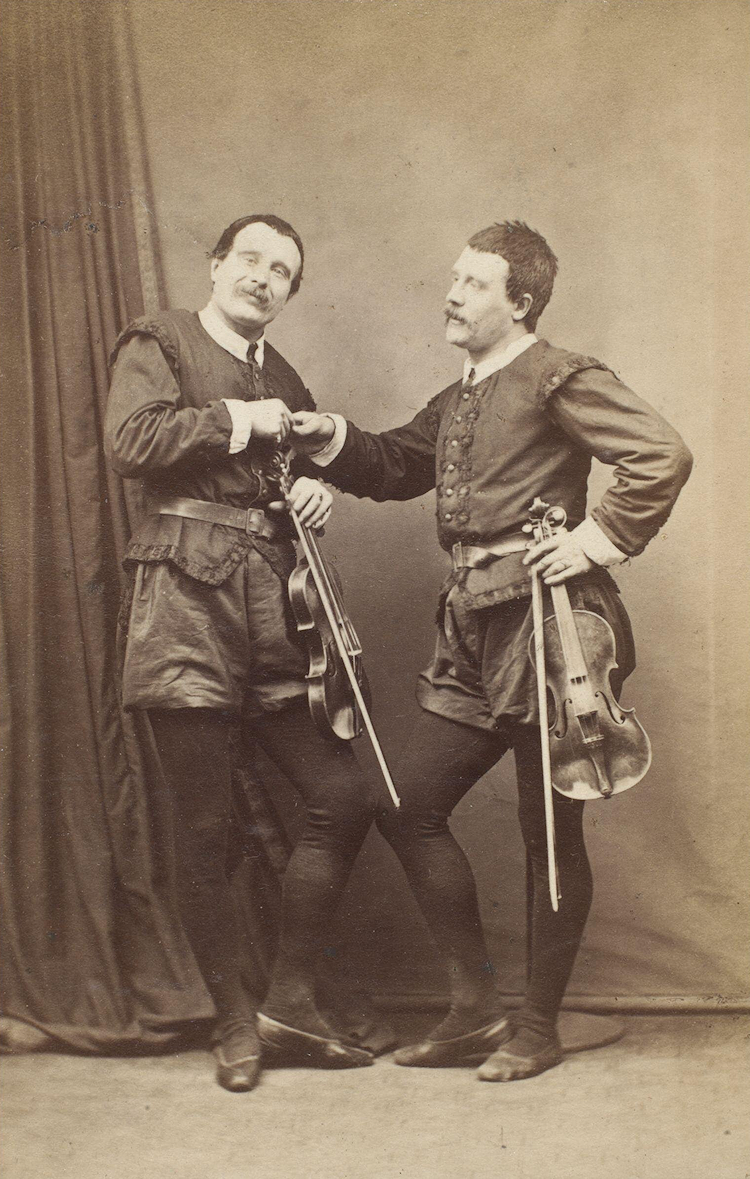
Artsists Aleksander and Maksymilian Gierymski posing for a preparatory photograph wearing historical costume. 
Courtesy Stephen Rutledge.


*

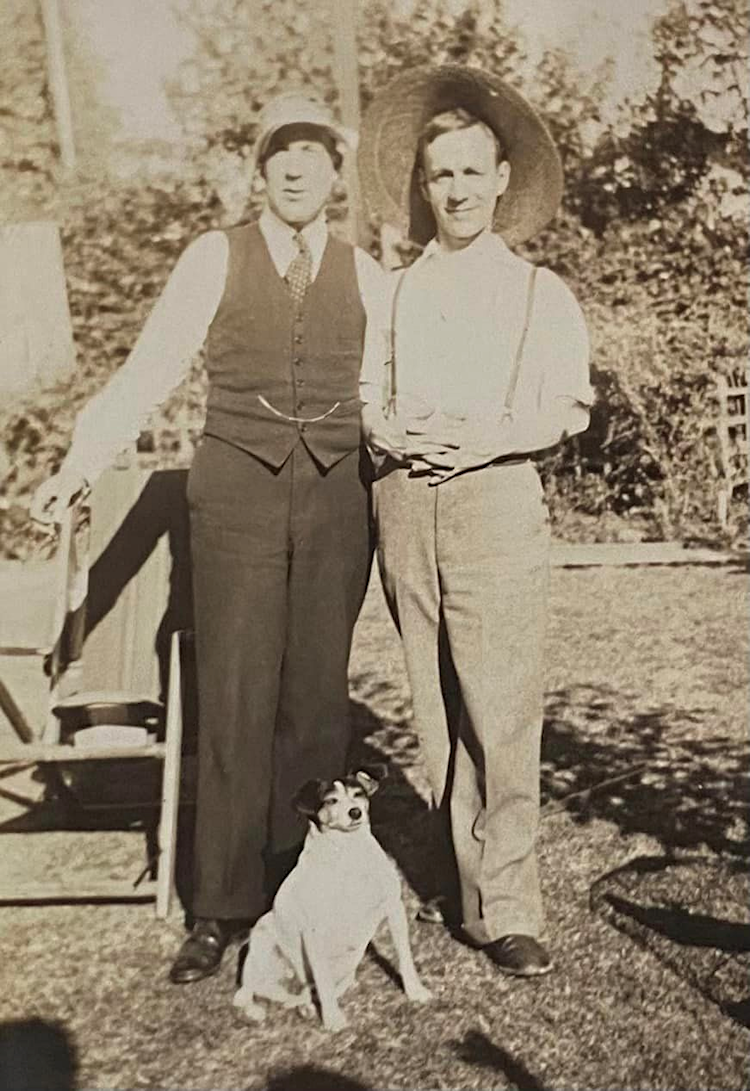
Friends, brothers, co-workers, and sometimes - rarely - even lovers. Many of these are the sort of vintage images frequently shared on social media with claims to be examples of same-sex relationships in the past, proof that "we've always been here", as if any half-sane individual could really argue against that point. But, while I'd love to think that these are indeed a record of men involved in loving and/or sexual partnerships, I can't allow myself to imagine that all but the rarest are. Even the images that appear to be overtly romantic or sexual were almost always posed as a display of racy humor rather than with the intent to make a very public record of genuine affections and implied activities that could never have been made public at all. What I feel confident they do record is the comfort men felt with same-sex physical contact before definitions of sexuality and ideas of appropriate masculine behavior became so rigidly codified, before displays of affection between men became so frowned upon. At any rate, I'm totally good without knowing anything of the particular relationships captured in the pictures shared here. I don't even feel compelled to imagine anything of their stories; for me, the images suffice.


Friday, June 21, 2024

Merely siblings - portraits of Francis and Elizabeth Burdett, by Francis Cotes

 
Elizabeth Burdett, 1767.
Francis Burdett, circa 1764-67.

This pair of portraits gives the impression of being pendants: in identical frames, facing toward each other, with matched light sources, similar backgrounds, and mirrored poses. But they weren't a romantic and/or married couple, rather brother and sister.


Elizabeth Burdett (circa 1742 - 1807) married, as his second wife, Francis Noel Clarke Mundy, a first cousin on his mother's side. Mundy was a poet, landowner, magistrate and, in 1772, became Sheriff of Derbyshire. They had two sons together, Francis Mundy who also became a Member of Parliament and, in 1820, Sheriff of Derbyshire, and Charles Godfrey Mundy. This portrait of their mother was formerly mistakenly identified as being of the subject's own mother, also named Elizabeth, the daughter of Sir Charles Sedley, 1st Baronet.


Francis Burdett (1743 - 1794), son of Sir Robert Burdett, 4th Baronet, predeceased his father (who died in 1797) and therefore failed to inherit the hereditary baronetcy. He had married in 1766, and it was his elder son, also named Francis, the reform-minded and controversial politician and Member of Parliament, who succeeded his grandfather as 5th Baronet. In turn, the latter's daughter was the famous philanthropist Angela Burdett-Coutts, 1st Baroness Burdett-Coutts.

Honestly, the real reason for this post was the rendering of Miss Burdett's gown; the handling of the blues and grays over the brown underpainting is exquisite.*

The present portrait of Francis Burdett is nearly identical to an earlier portrait that Cotes painted of the young gentleman, signed and dated 1764. Only the color of his suit and waistcoat have been changed.


*

Francis Cotes RA (20 May 1726, London - 16 July 1770, London), English portrait painter and a founding member of the Royal Academy in 1768. The eldest son of an apothecary, he trained with portrait painter George Knapton before setting up his own business in the premises of his father's business. An admirer of the work of Rosalba Carriera, he first concentrated on works in pastel and crayon - some of which became well known as engravings - but later worked in oils. He soon became one of the most fashionable portrait painters of his day. In 1763, he bought a large house in Cavendish Square - later occupied by George Romney - and helped found the Society of Artists of Great Britain, becoming its director in 1765. At the peak of his career, he was invited to become one of the first members of the Royal Academy, but died just two years later in Richmond at the age of forty-four. Francis's younger brother Samuel Cotes (1734 - 1818) was also an artist, specializing in miniatures.


* After 1746, the costumes in Cotes' paintings were mostly executed by specialist drapery painters. After the death in 1749 of Joseph van Aken, the leading drapery painter in England, he employed Peter Toms, who worked for Cotes until the latter's death. After that, Toms was employed as drapery painter for Sir Joshua Reynolds, Allan Ramsay, Benjamin West, and John Zoffany, amongst others. As I said above, my great appreciation for the very beautiful depiction of Elizabeth Burdett's gown was my one inspiration for this post. So, it's likely that I/we have the forgotten Peter Toms to thank for that and all this, not Cotes.


Sunday, June 16, 2024

The show, going on - the Payne Brothers, Harry and Fred


Harry and Fred Payne as, respectively, Clown and Harlequin, their best known roles.

Harry Payne (25 November 1833 - 27 September 1895) and Frederick Payne (January 1841 - 27 February 1880), brothers, British pantomime entertainers; when performing together, they were billed as The Payne Brothers. They became the chief pantomimists at Covent Garden, known for playing Clown - Harry - and Harlequin - Fred - both roles part of the Harlequinade that followed Victorian pantomimes. Together, the brothers appeared in Gilbert and Sullivan's first collaboration, Thespis, in 1871; the dancing of the Payne Brothers was so celebrated that W. S. Gilbert referred to it in two of his comic Bab Ballads, "The Bishop of Rum-ti-Foo" and "The Bishop of Rum-ti-Foo Again". When they appeared in the English language version of Offenbach's The Grand Duchess of Gerolstein, a reviewer in The Olio wrote, "People go rather to see the eccentric dancing than to hear the eccentric music. However, in justice to the latter, it may be urged that we have all heard enough of the Grand Duchess, while we are all agreed that we would never see sufficient of the Payne pantomimists - perhaps, taken for all in all, the best in the world."


Their father, William Henry Schofield "W. H." Payne (1804 - 18 December 1878), known as "the King of Pantomime", was an actor, dancer, and classic pantomime artist, who created much of the stage business connected with nineteenth century Harlequinades. Payne's elder son, Harry, began his career mostly in the role of Harlequin but in 1859, while playing a bear at Covent Garden, he had to take over as Clown in the middle of a performance when the actor performing that role collapsed; he would mostly perform as Clown - and to great acclaim - for the rest of his life. Thought by many to be the best clown of his time, Harry Payne died at the age of sixty-two and was buried in Highgate Cemetery.

Harry Payne in costume as Clown. (Eight images.)

Harry Payne opened each Boxing Day Harlequinade at Drury Lane with a somersault followed by a cheerful "Here we are again!" And while appearing as Clown at Drury Lane, he was responsible for the creation of one of the biggest Christmas crackers ever made during the Victorian era. It was over seven feet in length and contained a change of costume for the whole cast as well as hundreds of small crackers that the cast threw to the children in the audience.

Harry Payne in The Grand Duchess [of Gerolstein] at Covent Garden, 1867. (Two images.)
Harry Payne out of costume. (Three images.)

Into the 1870s, the younger brother, Fred, often performed with their father. When he appeared in Drury Lane's Cinderella in 1865, The London Review of Politics, Society, Literature, Art & Science said of his performance, "It would be difficult to find anything more truly humorous of its kind, than a combination of a fantastic hornpipe and an equally fantastic minuet, danced by Mr. Frederick Payne...." But he later became best known for his performances with his brother, most often in the role of Harlequin. But in 1877, while engaged in the pantomime at the Alexandra Palace, he became what the newspaper The Era called mentally "affected". He never fully recovered from this affliction - whatever it actually was - and died three years later at the age of only thirty-nine.

Fred Payne.
Fred Payne as Népomuc in The Grand Duchess [of Gerolstein] at Covent Garden, 1867. (Four images.)
As Harlequin. (Two images.)

*

These images are all in the collection of the Victoria and Albert Museum.


Friday, June 14, 2024

On HER birthday


Today, the 14th of June, is my most excellent wife's birthday. 

An incredible person, my respect for her is only surpassed by my love.

And it would be impossible to overstate how much better she's made my life.

Odd, then, that in almost twenty years together, I've only included her in four paintings.

Les Deux - acrylic on panel - 24x18 - 2009.
À la nuit tombante - acrylic on panel - 24x36 - 2011.
G en travesti in men's clothing, me in a gown. Our relative heights were mucked about with here; in reality, I'm almost a foot taller than G.
Les Amis, les amants - acrylic on panel - 36 x 24 - 2014.
With our little dog, Nicholas.
There really is a "G" tattooed on my wrist; perhaps you'll get the reference...?
After 'Le Déjeuner sur l'herbe' by Manet - acrylic on panel - 30x40 - 2021.

*

Only four paintings? That's rather terrible; Nicholas has made it into SIX! Something really must be done about this situation....