L a - b e a u t é - s a u v e r a - l e - m o n d e ~ D o s t o ï e v s k i

L a - b e a u t é - s a u v e r a - l e - m o n d e  ~  D o s t o ï e v s k i


Sunday, February 4, 2024

Not vanish - portraits by Elbridge Ayer Burbank

 
 Gi-aum-e Hon-o-me-tah, 1897.
Pah-Puh, 1898.
Poe-Shom-Ee, 1904.
Quen-Chow-A, 1897.
Christian-Naiche, circa 1899.
Chief Black-Coyote, 1901.
Tlo-Be-Nel-Ly, 1910.
Pah-Lah-Wool-Ey, 1904.
A-A-Wah, 1904.
Chief Po-Ka-Gon (Simon Pokagon), 1898.
Night-Killer, circa 1890s.
O-Ko-A-Po-Bi, circa 1900. I believe this to be a vintage print made after the original painting.
Mother and Children, 1908.
Chief Geronimo, 1899.
Shield, 1899.
Zy-You-Wa. This is a vintage print made after the original painting.
Wick-Ah-Te-Wah, 1898.
Curley, 1897.
Pahl-Lee, 1898.
Two portraits of Ton-Had-Dle, 1899.
Rain-in-the-Face, circa 1890s.
Ho-Mo-Vi, 1898.
Rah-Ah-Rah and Baby, Juane, 1898.

(I'm very uncertain about the spelling and, especially, the correct usage of capitalization in the Native American names. I've tried, without success, to verify the proper forms. So I apologize if I've totally mucked it up.)

*

Elbridge Ayer (E. A.) Burbank (10 August 1858, Harvard, Illinois - 21 April 1949, San Francisco),  American artist known for his portraits of Native Americans; by 1914 he'd completed more than twelve hundred, from one-hundred and twenty-five tribes. After attending public schools, he enrolled at the Chicago Academy of Design, and later completed two periods of extended study in Munich, 1886-87 and 1889-1890. His maternal uncle Edward E. Ayer was a successful business magnate, museum philanthropist, and antiquarian collector of books, original manuscripts, and other materials relating to the history and ethnology of Native American peoples at the time of European encounter. This would appear to have some influence on the nephew's artistic focus. Over a period of several years, Burbank spent many months at the Hubbell Trading Post in Arizona, where he studied and painted Native Americans; he also spent time at Fort Sill in Oklahoma and at Pine Ridge Agency in South Dakota. He painted portraits of the greatest living Native American leaders, including Geronimo, Red Cloud and Chief Joseph; he is believed to be the only person to paint the military and spiritual leader Geronimo from life. The eighty-year-old Oglala Lakota Chief Blue Horse who had befriended Burbank, called him “Son of the Shadow-Maker.” As an adult, Burbank was diagnosed with what would now be called bipolar disorder. He was treated at several different facilities during his life, most notably for more than ten years at the State Mental Hospital in Napa, California. He died at the age of ninety in San Francisco, after being struck and severely injured, three months earlier, by a cable car.

*

As an example of how tricky it can often be when preparing images for my blog posts, these are the two versions I found of the portrait of Ton-Had-Dle shown above. Both were good quality images, both from very respectable websites. So how, without being able to see the work in person, would I know which - if either - most closely resembled the actual article...?


Friday, February 2, 2024

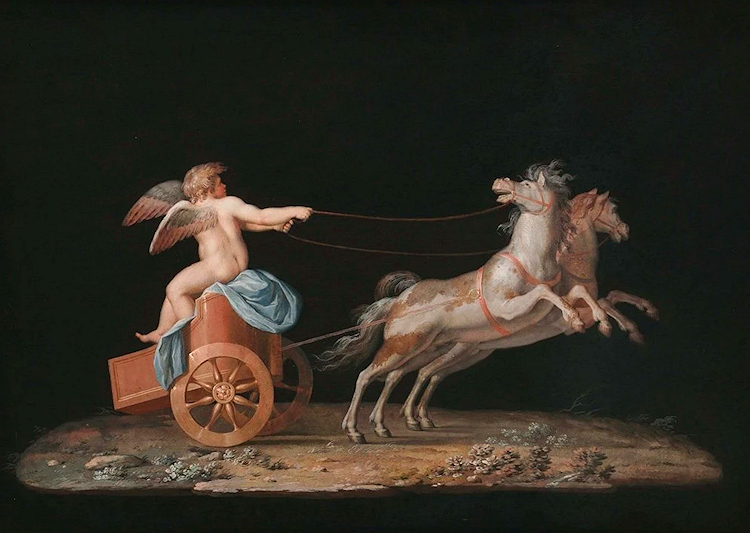
Cupid on the move - mythological whimsy by Michelangelo Maestri


The paintings here are in gouache, though some of the images may actually be of hand-colored engravings after the originals. In several instances, there are multiple versions of the same design, with only small variations. Lastly, I can't be certain that all these are by the hand of Maestri. Some may be copies "after Maestri, "the school of", "studio of", etc.

Two versions of the same design.
Three versions of the same design.
Two versions of the same design, reversed.
Two versions of the same design.
Three versions of the same design.

*

Michelangelo Maestri (1741, Rome - 1812, Rome), Italian artist. His best known compositions were based on motifs from frescos discovered in Pompeii and Herculaneum, and from designs by Raphael or the latter's pupil Giulio Romano. His work was frequently purchased by European travelers during their Grand Tour. Some of his subjects that were most popular with collectors portray putti leading animals from a chariot or other conveyance - realistic or fantastical - and were inspired by ceiling frescoes in the salone of the Villa Lante in Rome. Francesco Piranesi and Tommaso Piroli published a series of engravings of these frescoes in 1805, attributing each design to Giulio Romano. Maestri likely knew these engravings as his titles inscribed below the images are similar to those recorded by Piranesi and Piroli.