L a - b e a u t é - s a u v e r a - l e - m o n d e ~ D o s t o ï e v s k i

L a - b e a u t é - s a u v e r a - l e - m o n d e  ~  D o s t o ï e v s k i


Friday, February 16, 2024

All in the family - portraits of Rubens Peale

 
"Rubens Peale with a Geranium," by Rembrandt Peale, the sitter's older brother, 1801.
Miniature portrait by Anna Claypoole Peale, the sitter's first cousin, 1822. 
Watercolor on ivory, 2 7/8 x 2 1/4 inches.
"Rubens Peale as a Mascot," by Raphaelle Peale, the sitter's eldest bother, 1795.
Miniature portrait by Raphaelle Peale, circa 1801.
Watercolor on paper, 3 3/4 x 2 5/8.
A second portrait by Rembrandt Peale, 1807.

*

Rubens Peale (4 May 1784, Philadelphia - 17 July 1865, Philadelphia), American museum administrator and artist, the fourth son of artist-naturalist Charles Willson Peale. Due to his weak eyesight, he did not set out to be an artist, unlike most of his siblings; it was not until the last decade of his life that he began to take up painting seriously. In 1803 he attended classes at the University of Pennsylvania and was director of his father's museum in Philadelphia from 1810 to 1821, and then of the Peale Museum in Baltimore, which he ran with his brother, Rembrandt Peale. He married in 1820 - he and his wife would have seven children - and he opened his own museum in New York in 1825. The Panic of 1837 sent his museum into debt and eventually, in 1843, he was forced to sell his entire collection to P.T. Barnum. He retired to the estate of his father-in-law, near Schuylkill Haven, Pennsylvania, and lived as something of a country gentleman, at Woodland Farm. He experimented with mesmerism, and wrote to his brother Rembrandt about it. In 1855, he began keeping a journal and turned to still-life painting as an extension of his interest in natural history. In 1864, he returned to Philadelphia, and studied landscape painting there with Edward Moran. In the last ten years before his death at the age of eighty-one, he produced one-hundred and thirty paintings. 

 Detail of "Rubens Peale with a Geranium."

His only daughter, Mary Jane (1826 - 1902), was among the last members of the Peale family to paint professionally, having studied with her uncle Rembrandt. She is actually sometimes credited with teaching her father to paint, after his retirement. There is also evidence that some of the works attributed to him may have instead been collaborative creations between the two. And after her father's death, Mary Jane completed his unfinished paintings.


Sunday, February 11, 2024

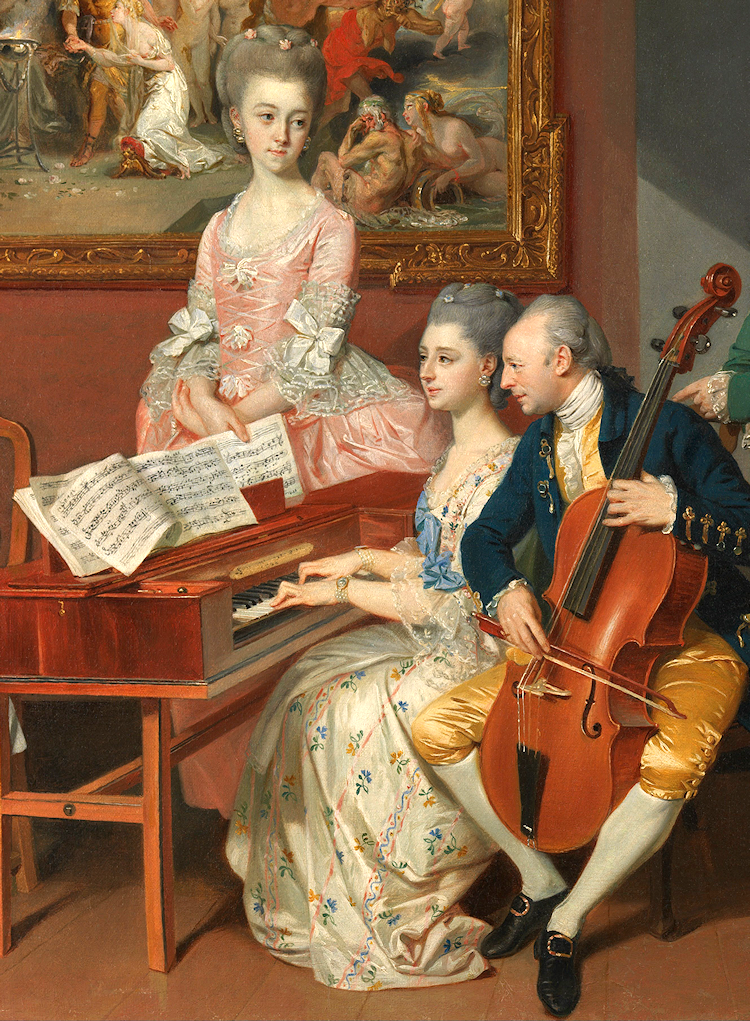
An engagement in Florence - The Gore Family with George, 3rd Earl Cowper, by Johan Zoffany, circa 1775


This "conversation piece" marked the engagement of George Nassau Clavering-Cowper, 3rd Earl Cowper (1738 - 1789) to the Hannah Anne Gore (circa 1758 - 1826), the sixteen-year-old youngest daughter of Charles Gore (1729 -1807); the father of the fiancée commissioned the painting. Hannah Gore - who usually went by her middle name, Anne - and Lord Cowper are portrayed standing. Charles Gore is shown playing the cello, his middle daughter, Emilie, at the keyboard. Mrs. Gore, née Mary Cockerill, is seated at far right with the couple's eldest daughter, Elizabeth.


Lord Cowper was a wealthy art collector, patron, and member of Parliament. When still Viscount Fordwich, he had completed his education by taking the English aristocrat's requisite Grand Tour of the continent. But arriving, finally, in Florence in 1759, he was so taken with the city that he remained; he was also taken by a beautiful Florentine woman, a certain Marchesa Corsi. By the time his passion for the lady eventually faded, he had been thoroughly caught up in the culture and social life of Florence, and repeatedly stayed his departure for home. (He apparently only once returned to England - and briefly - more than thirty years later, just three years before his death.) 


Fifteen years on, in 1774, Charles Gore - described as a "widely travelled, cultured gentleman with artistic tastes" - took his wife and three daughters to Florence, where Hannah met Lord Cowper. The two were married there in June of the following year. In 1780, Cowper bought the Villa Palmieri in Fiesole overlooking Florence. The couple had three sons; the first two would become the 4th and 5th Earl Cowper in succession.

Charles Gore, independently wealthy through his marriage, was an amateur artist; the watercolor of ships is likely a representation of his work.

The fictive mythologically-themed painting in the background has come in for some discussion. Said to represent Hercules - emblematic of virtue - driving Envy or Calumny from a wedding ceremony being held in the Temple of Hymen, some have seen it as sly reference to Lord Cowper's past relationship to the Marchesa Corsi or to the presently necessary curtailment, with his impending marriage, of his liaisons with other Florentine women.


Friday, February 9, 2024

Homegrown Forties chic - Adrian wool coat, circa 1945


Adrian, arguably the greatest and probably the most remembered of the legendary Hollywood costume designers of the Thirties, left MGM, his home studio for thirteen years, in 1941, when his contract expired. He had likely been planning this for some time, as only a few months later he reappeared, in business as Adrian, Ltd. in Beverly Hills. The timing of this new venture's debut was fortuitous, with the war in Europe on and all contact with Paris fashion severed. At any rate, Adrian, Ltd. proved quite successful, critically and popularly, and the designer exerted a strong influence on American fashion until the late 1940s.

The wide shawl collar could also be worn close around the neck; the buttonhole was hidden in the seam. (I love that.)

Coat front, collar, and back yoke in black & white pinstripe wool, with solid black piping; coat back and sleeves of solid black wool; inset black waistband; large button back pockets. Sold by Augusta Auctions in 2016.


Sunday, February 4, 2024

Not vanish - portraits by Elbridge Ayer Burbank

 
 Gi-aum-e Hon-o-me-tah, 1897.
Pah-Puh, 1898.
Poe-Shom-Ee, 1904.
Quen-Chow-A, 1897.
Christian-Naiche, circa 1899.
Chief Black-Coyote, 1901.
Tlo-Be-Nel-Ly, 1910.
Pah-Lah-Wool-Ey, 1904.
A-A-Wah, 1904.
Chief Po-Ka-Gon (Simon Pokagon), 1898.
Night-Killer, circa 1890s.
O-Ko-A-Po-Bi, circa 1900. I believe this to be a vintage print made after the original painting.
Mother and Children, 1908.
Chief Geronimo, 1899.
Shield, 1899.
Zy-You-Wa. This is a vintage print made after the original painting.
Wick-Ah-Te-Wah, 1898.
Curley, 1897.
Pahl-Lee, 1898.
Two portraits of Ton-Had-Dle, 1899.
Rain-in-the-Face, circa 1890s.
Ho-Mo-Vi, 1898.
Rah-Ah-Rah and Baby, Juane, 1898.

(I'm very uncertain about the spelling and, especially, the correct usage of capitalization in the Native American names. I've tried, without success, to verify the proper forms. So I apologize if I've totally mucked it up.)

*

Elbridge Ayer (E. A.) Burbank (10 August 1858, Harvard, Illinois - 21 April 1949, San Francisco),  American artist known for his portraits of Native Americans; by 1914 he'd completed more than twelve hundred, from one-hundred and twenty-five tribes. After attending public schools, he enrolled at the Chicago Academy of Design, and later completed two periods of extended study in Munich, 1886-87 and 1889-1890. His maternal uncle Edward E. Ayer was a successful business magnate, museum philanthropist, and antiquarian collector of books, original manuscripts, and other materials relating to the history and ethnology of Native American peoples at the time of European encounter. This would appear to have some influence on the nephew's artistic focus. Over a period of several years, Burbank spent many months at the Hubbell Trading Post in Arizona, where he studied and painted Native Americans; he also spent time at Fort Sill in Oklahoma and at Pine Ridge Agency in South Dakota. He painted portraits of the greatest living Native American leaders, including Geronimo, Red Cloud and Chief Joseph; he is believed to be the only person to paint the military and spiritual leader Geronimo from life. The eighty-year-old Oglala Lakota Chief Blue Horse who had befriended Burbank, called him “Son of the Shadow-Maker.” As an adult, Burbank was diagnosed with what would now be called bipolar disorder. He was treated at several different facilities during his life, most notably for more than ten years at the State Mental Hospital in Napa, California. He died at the age of ninety in San Francisco, after being struck and severely injured, three months earlier, by a cable car.

*

As an example of how tricky it can often be when preparing images for my blog posts, these are the two versions I found of the portrait of Ton-Had-Dle shown above. Both were good quality images, both from very respectable websites. So how, without being able to see the work in person, would I know which - if either - most closely resembled the actual article...?