L a - b e a u t é - s a u v e r a - l e - m o n d e ~ D o s t o ï e v s k i

L a - b e a u t é - s a u v e r a - l e - m o n d e  ~  D o s t o ï e v s k i


Showing posts with label Catherine the Great. Show all posts

Sunday, February 27, 2022

Shaming nature - jeweled bouquets by Jérémie Pauzié, circa 1740s


Jérémie Pauzié (sometimes spelled "Posier", which appears to be a re-transliteration back from the Cyrillic: 6 December 1716, Geneva – 30 November 1779, Geneva), Swiss jeweler, artist, and memoirist, best known for his work for the Russian Imperial court and for the Imperial Crown of Russia, which he created in conjunction with court jeweler Georg Friedrich Ekart.


He studied for seven years with Benedict Gravero in Saint Petersburg, but soon the student surpassed the skill of the master. In 1740, under the patronage of Empress Anna Ioannovna, he opened his own small workshop and received the title of the court jeweler. He specialized in setting diamonds and other precious stones; for work with unornamented metals, he hired subcontractors. During the reign of Anna's successor, the Empress Elizabeth, his fame and influence continued to grow, which often put him at odds with  Ekart, the chief court jeweler. Besides his work for the empress, he produced much jewelry for the aristocracy.


The Empress Elizabeth died in 1761, and after disposing of her inconvenient husband, Catherine the Great ascended the throne the following year. For her coronation - rushed to gloss over her usurping of power - both of the rival jewelers were entrusted with the making of a new Imperial Crown, the creation of which proved contentious. Pauzié's artistry prevailed, though, and the massive crown was a great success in spite of everything and was subsequently worn at every coronation until the fall of the empire. Having survived the Soviet sales of Romanov treasure, the crown remains today on display in the Moscow Kremlin Armoury Museum.


Pauzié left Saint Petersburg in 1764 and returned to Switzerland. In 1770 he once again settled in the place of his birth where he died nine years later. His "Memoirs of a Court Jeweler" were published in Russia in 1870.

Portrait of Pauzié by an unknown artist, 1762.


Friday, June 7, 2019

An empress, twice over - Catherine II by Vigilius Eriksen, circa 1762


This has long been one of my favorite portraits and certainly my favorite portrait of the Empress - even though I'd never seen a decent image of it. It always looked quite dirty, with big patches of very yellowed varnish. It was unfortunate - and seemed rather odd - that such an important painting would be languishing in so poor a state. But now that it's been properly cleaned and restored, Eriksen's compositional and painterly skill can finally be fully appreciated.


The artist painted the Empress on several occasions, and this is considered one of the most satisfying portraits of the oft-portrayed subject. (It's also thought to be one of the painter's most successful pieces.) Eriksen used a very successful approach to the composition, allowing him to show Catherine both full-face and in profile. Intentionally or merely fortuitously, in doing so he manages to capture the contrasting aspects of the Empress' complicated character: the profile is severe, commanding, befitting the ruler of a vast empire - an image fit for a coin - while the face turned to the viewer is that of a charming, intelligent, and very cultured woman.

For the record, this is how you paint diamonds.

The Empress was portrayed shortly after she came to the throne in 1762, and is depicted wearing the sash, star and badge of the Order of St. Andrew as well as the Small Imperial Crown. On the cushions in front of the mirror are the remainder of the imperial regalia: the Large Imperial Crown, created by the Swiss jeweler Jérémie Pauzié especially for the coronation, the sceptre and the orb. The earliest mentions of the portrait date from 1762–63. In the 19th century, the painting hung in the Romanov Gallery of the Small Hermitage among other portraits of members of the House of Romanov.

Before restoration - though it might already have had some cleaning.

From the Hermitage website:

The restoration project included the following work: strengthen of the primer and paint layer across the entire surface; removal of superficial soiling; test removals of varnish and overpaintings; thinning and smoothing of the old varnish layer across the entire surface of the painting; removal of old restoration modifications of colour; second restoration of varnish; new coating of varnish; making good losses of paint.


In the middle of restoration, with old restorations and overpaintings removed.
After restoration.


Sunday, May 12, 2019

The Orlov brothers - two equestrian portraits by Vigilius Eriksen, circa 1766


Count Grigori Grigorievich Orlov. The two paintings measure more than thirteen by eleven and a half feet.

These portraits by the Danish painter Vigilius Eriksen are of the two most celebrated of the five Orlov brothers. Count Grigori Grigorievich Orlov (1734–1783), pictured above in Roman costume, was a lover of the Empress Catherine the Great and one of her closest advisors; he fathered her illegitimate son, Alexei, born the same year as the coup d'état which deposed Catherine's husband and secured her place as sole ruler of Russia. Virtually her co-ruler for some years, he was supplanted by Grigori Potemkin in 1774.

Count Alexei Grigorievich Orlov.

Count Alexei Grigorievich Orlov (1737–1808), depicted in Turkish dress, was one of Catherine’s most important military and diplomatic leaders. The ablest of the Orlov brothers, he was integral to Catherine's plot to take power in 1762; some sources claim he participated in the resulting death of Peter III, that he conveyed the Emperor to Ropsha Palace and even participated in his murder, though the circumstances of Peter's death are much disputed.

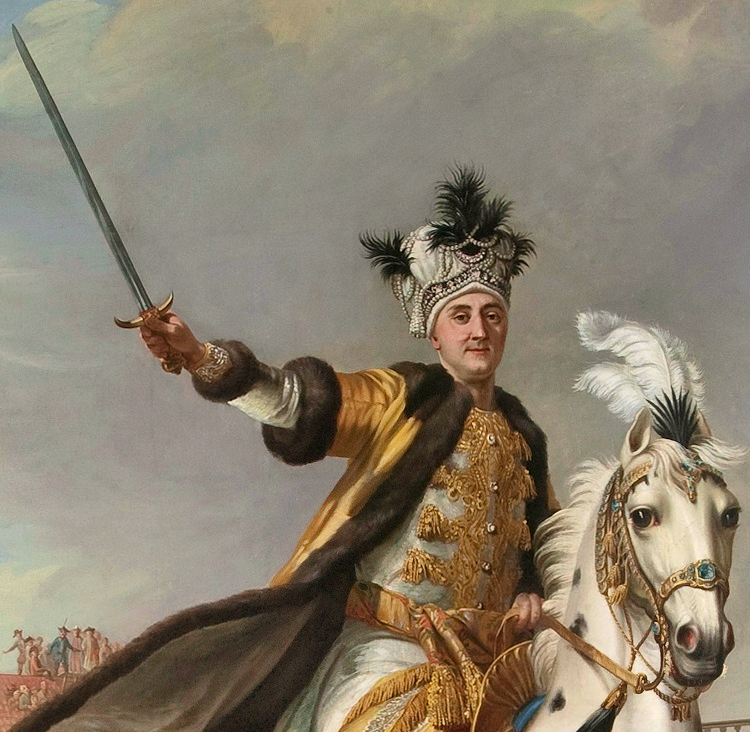
In 1766, Catherine the Great ordered the first Russian "carousel," an exhibition of horseback riding, swordsmanship, and shooting then popular in all the great courts of Europe. While the event was repeated in subsequent years, no later celebration inspired as much artistic and literary creativity as the first; there are references to the event in the works of Casanova, Voltaire, and others, as well as numerous paintings and other works of art. These large equestrian portraits commemorate the prominent participation of the Orlov brothers, still the most influential figures at court. Eriksen was Catherine's court painter in the early years of her reign and is responsible for many of the best known images of the Empress.


*

The portraits hung in the Winter Palace until the death of the Empress in 1796. Paul I began his reign by clearing away any reference to his mother's long succession of lovers, and these paintings were shut up in warehouses for many years. Sent to the Court Stable Chancellery in 1827, during the reign of Nicholas I, they found their way to the Gatchina Palace six years later. During World War II, in advance of the Nazi occupation, there was a mass evacuation of the art treasures resident in the suburban palace-museums outside of St. Petersburg; it is likely these were part of that exodus. After the war, they were returned to the repository of art and furnishings held at the Pavlovsk Palace Museum and, in 1958, handed off to the Hermitage and stored in the Central Warehouse of Museum Holdings.

The two paintings in the early stages of restoration.

These paintings were stored in rolls for decades. This type of storage - where the painting is taken from the frame and then detached from its stretcher - is generally used as only a temporary, emergency measure, and is the result of a number of reasons, among which is the need to transport overly large paintings, or where there is the lack of space or the proper conditions for storing such works of art in any other manner. One way or another, these canvases had been languishing in this state probably since World War II. Previously only known from black and white reproductions - to the public and museum curators alike - they were finally unrolled less than a decade ago and have now been restored.


Friday, June 22, 2018

Twelve miniature portraits of the Zubov / Suvorov family, unknown artists, late eighteenth - early nineteenth centuries


The various artists are unknown.

These twelve miniatures represent various members of the family of Count Nikolai Zubov (1763-1805) and his wife, Natalia Zubova, née Suvorova (1775-1844). Alexander Suvorov was one of the greatest military leaders in Russian history; Nikolai Zubov served under him and married his only daughter, Natalia. Both families benefited when, at only twenty-two, Nikolai's younger brother Platon became the final favorite of Catherine the Great and, contrary to expectation, instead of being a passing fancy of the aged monarch, soon found himself the most powerful man in Russia; he was made a prince, and his brothers, counts. Catherine's death in 1796 meant exile for both Platon and Nikolai. Platon would die in exile, but Nikolai returned to Russia five years later as one of the conspirators in the murder of Emperor Paul. He survived the tsar by just four years, dying at the age of only forty-two.

General Alexander Suvorov (1730-1800) and his wife, Varvara Suvorova, née Prozorovskaia (1750-1806), parents of Natalia Zubova.
Presumably Avdotya Suvorova, née Manukova (?-circa 1740), and Vasily Suvorov (1705-1775), parents of Alexander Suvorov.
Arkady Suvorov (1780-1811), son of Alexander Suvorov, brother of Natalia Zubova.
Count Nikolai Zubov (1763-1805), husband of Natalia Zubova, née Suvorova.
Natalia Zubova, née Suvorova (1775-1844), daughter of Alexander Suvorov, wife of Count Nikolai Zubov, sister of Arkady Suvorov.
Prince Platon Zubov (1767-1822), brother of Count Nikolai Zubov and - famously - the last favourite of Catherine II.
Presumably the sons of Count Nikolai Zubov and Natalia Zubova: Alexander (1797-1875), Platon (1798-1855)... 
... And Valerian (1804-1857). Count Alexander Zubov (1727-1795), father of Nikolai and Platon Zubov.


Friday, March 9, 2018

The counts Bobrinsky - and other lofty Russian gentlemen in Daguerreotypes and portraits


Count Alexei Alexeievich Bobrinsky, 1842.

Count Alexei Alexeievich Bobrinsky (8 January 1800 – 4 October 1868), Russian nobleman, the son of Count Alexei Grigorievich Bobrinsky who was the illegitimate offspring of Empress Catherine II and her lover Count Grigori Orlov. The second Count Bobrinsky married Sophia Alexandrovna Samoilova (1797-1866) in 1821; the couple would have three sons together: Alexander (May 17, 1823 – February 24, 1903), Vladimir (2 October 1824 – 28 May 1898), and Lev (8 November 1831 – 23 March 1915).

1842.
1844.
Portrait by Winterhalter, 1844.

*

Count Alexander Alexeievich Bobrinsky, 1850.
1842.
Circa 1840s.
Portrait by Franz Krüger, 1850.

*

Count Vladimir Alexeievich Bobrinsky, 1845.
Circa 1846.
1844.

***

Count Pavel Sergeievich Stroganov, circa 1850s.
Prince Nikolai Borisovich Yussupov, circa 1850s
Grand Dukes Nikolai Nikolaievich, Konstantin Nikolaievich, and Mikhail Nikolaievich, circa late 1840s-early 1850s.
Grand Duke Nikolai Nikolaievich, by Sergei Zaryanko, 1853.
Grand Duke Mikhail Nikolaievich, by Richard Lauchert, 1857.
Grand Duke Konstantin Nikolaievich, unknown artist, circa late 1840s-early 1850s.
Grand Duke Konstantin Nikolaievich, circa late 1840s-early 1850s.