L a - b e a u t é - s a u v e r a - l e - m o n d e ~ D o s t o ï e v s k i

L a - b e a u t é - s a u v e r a - l e - m o n d e  ~  D o s t o ï e v s k i


Tuesday, November 18, 2014

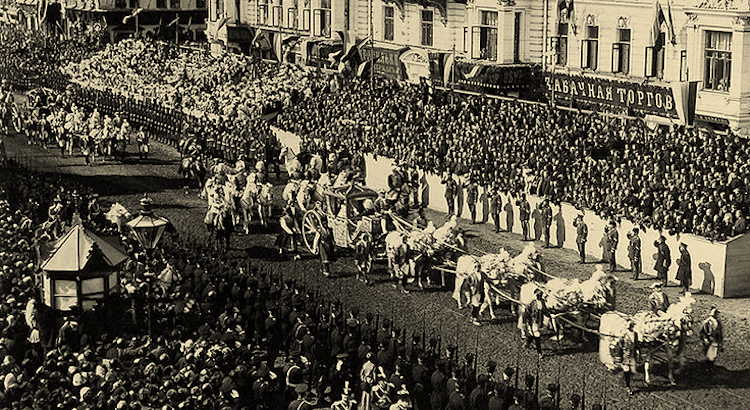
The mother and wife of Nicholas II arriving in Moscow for his coronation, May 1896


The Dowager Empress has a model of a crown attached to the top of her carriage...
... while her daughter-in-law - not yet crowned - does not.
The Imperial ladies having descended from their carriages, they are joined by the Tsar, while their trains are arranged by court pages. The Tsar's
uncle, Grand Duke Sergei Alexandrovich, Governor General of Moscow, stands directly behind his nephew.


Monday, November 17, 2014

Barbara Stanwyck, in Edith Head, circa early 1940s


Stanwyck looking very... well, very Stanwyck. And wearing a gown by her favorite designer - and close friend - Edith Head. I haven't been able to tell if this gown was worn in a film or was just run up for publicity purposes, but it's quite similar to those worn by Stanwyck in Preston Sturges' wonderful The Lady Eve.


Sunday, November 16, 2014

The Empress Maria Theresia, by Jean-Étienne Liotard, 1747


Maria Theresia Walburga Amalia Christina (13 May 1717, Vienna 29 November 1780, Vienna), the only female ruler of the Habsburg empire, she was the sovereign of Austria, Hungary, Croatia, Bohemia, Mantua, Milan, Lodomeria and Galicia, the Austrian Netherlands, and Parma. By marriage, she was Duchess of Lorraine, Grand Duchess of Tuscany, and Holy Roman Empress.

Unlike most of his best known work, this portrait is painted in enamel on copper.

Her 40-year reign began at the death of her father, Emperor Charles VI, in 1740. Charles VI had paved the way for her accession with the Pragmatic Sanction of 1713 and spent his entire reign securing it. (Upon his death, Saxony, Prussia, Bavaria, and France all repudiated the sanction they had recognized during his lifetime, and Prussia proceeded to invade the affluent Habsburg province of Silesia, sparking a nine-year conflict known as the War of the Austrian Succession.) Though she had been expected to cede power to her husband Francis I, Holy Roman Emperor, and, later, to her eldest son Joseph, both of whom were officially her co-rulers in Austria and Bohemia, Maria Theresia was the absolute sovereign who ruled with the counsel of her advisers. She instituted financial and educational reforms, spurred business and agricultural development, and reorganized the military, all of which greatly strengthened Austria's international standing. The Empress also understood the importance of her public persona and was able to simultaneously evoke both esteem and affection from her subjects.


She and her husband had sixteen children. Among the thirteen who survived infancy were Queen Marie Antoinette of France, Queen Maria Carolina of Naples, Duchess Maria Amalia of Parma, and two Holy Roman Emperors, Joseph II and Leopold II; the marriages of her all children would be carefully calculated to ensure the most political gain for Austria. Though her own marriage had also been an arranged one, the Empress was very much in love with her husband and was devastated at his death in 1765; for the remaining fifteen years of her life she wore mourning and completely withdrew from court and public life. Her health was severely compromised by an attack of smallpox in 1767, but she remained resolutely in command until her death at the age of sixty-three.


***

Jean-Étienne Liotard (22 December 1702, Geneva – 12 June 1789, Geneva), Swiss-French artist of great versatility, though his fame depends largely on his cool and sharp-focused pastel drawings; after Maurice Quentin de La Tour, he is probably the greatest of the great eighteenth-century French pastelists. After studying with masters in his home town of Geneva, he went to Paris in 1725 and, later, he was resident in Naples, Rome, and Constantinople. His time spent in the latter proved to be very influential on his art -- and on his personal appearance; he painted many genre scenes and portraits in which the European subjects are dressed in a version of Turkish attire, and his own very eccentric adoption of Oriental dress and a long beard earned him the nickname le peintre turc, the Turkish painter. He went on to work in Vienna, London, and the Netherlands, before returning to Geneva in 1776. He devoted his last years to writing a treatise on painting, and working at still lifes and landscapes. He died at the age of eighty-six.

Saturday, November 15, 2014

Gowns by Vionnet, 1937, 1938, 1939


Madeleine Vionnet (22 June 1876, Chilleurs-aux-Bois – 2 March 1975, Paris), one of the greatest, most innovative, most influential fashion designers of all time. Referred to as the "queen of the bias cut" and the "architect among dressmakers", she is best known for the simple elegance of her classically-inspired designs and for popularizing the bias cut; aided by the enthusiastic embrace of Hollywood, the bias cut became the look of the Thirties.


Born into a poor family, and with hardly any education, she began her apprenticeship as a seamstress at the age of twelve. After a brief marriage at eighteen and the loss of a child, she left her husband and went to London to work as a seamstress in a hospital. There, she began working as a fitter for the dressmaker Kate Reily, but eventually returned to Paris where she worked for six years at the fashion house of Callot Sœurs as a toile maker. (A toile is a designer's test garment; in the United States it is usually referred to as a "muslin".) Her own tastes were at odds with the often elaborately decorated Callot house style, but Vionnet always noted the importance of her years there, saying, "without the example of the Callot Sœurs, I would have continued to make Fords. It is because of them that I have been able to make Rolls Royces."


She went on to design for Jacques Doucet between 1907 and 1911, and in 1912 she opened her own house, only to close it two years later at the advent of World War I. But she re-established the house in 1923, opening new premises on the Avenue Montaigne. Only a few years after that she opened premises in New York. Her work was hugely influential, especially during the early Thirties. She was highly regarded by her fellow couturiers, and she led the fight for copyright laws in fashion. She also employed what were considered revolutionary labor practices at the time: paid holidays, maternity leave, day-care, a dining hall, and a resident doctor and dentist. She was forced to close her house once more, at the coming of World War II in 1939, and retired the next year. She lived for thirty-five more years, passing away at the age of ninety-eight.


Unlike her great contemporary Chanel, Vionnet had no taste for self-promotion, and that, combined with her early retirement, has had the result that her name is not as generally well known as it should be. But like Chanel, her designs have a timelessness that ensures that the particulars of line and drape and ornamentation that she created continue to reappear - again and again, year after year - in the work of her design successors; which of the gowns shown here would be wrong today, on any lovely, celebrated woman on any red carpet?


These designs are from some of her last collections. I love the subtle variations in the garments pictured - a particular skirt will have two different bodices - and the changing but consistently imagined ornamentation; there is sort of mutation in some of the patterning from dress to dress. (And I'm so glad we have access to some of the original photographic documentation, as the ugly mannequins and the flattened, wrinkled state of the surviving garments, in the more recent images here, most definitely do not show the dresses at they ought to be seen.)

The same dress as above, but looking quite a bit less fresh....


Friday, November 14, 2014

Diaghilev and Nijinsky, Nice, 1911


Impresario and protégé in 1911. The year of Petrushka, Le Spectre de la Rose; the return of  Schéhérazade, Carnaval, Les Sylphides; the expectation of L'Après-midi d'un faune, Le Sacre du printemps. Two great artists at the height of their careers, the height of their partnership, the height of their relationship.


Thursday, November 13, 2014

Allan Ramsay: portraits of his two wives


Portrait of Margaret Lindsay (detail).

Allan Ramsay (13 October 1713, Edinburgh – 10 August 1784, Dover), Scottish artist, one of the greatest of the eighteenth century British portrait painters.

Portrait of Anne Bayne, circa 1739.

The eldest son of his namesake poet father, at twenty he went to London to study, privately and at the St. Martin's Lane Academy. In 1736 he left for Rome and Naples; he remained in Italy for three years. He then returned to Edinburgh, but soon settled once again in London where he was increasingly successful as a portrait painter. In 1739 he married Anne Bayne, the daughter of a law professor, but his wife died in childbirth four years later, and none of their three children survived childhood. Nine years after his first wife's death, in 1752, he eloped with a student of his, Margaret Lindsay (circa 1726 - 1782), the eldest daughter of a Scottish baronet, Sir Alexander Lindsay of Evelick, who was scandalized at his daughter marrying an artist; he never forgave her. But the marriage was a happy one, with three children surviving to adulthood.

Portrait of Margaret Lindsay, circa 1758.

From 1754 to 1757 the couple traveled in Italy. This and other trips to Italy involved more literary and antiquarian research than art, but Ramsay also earned some income painting portraits of travelers making the Grand Tour. In 1761 (officially 1767) he was appointed Principal Painter in Ordinary to George III. The King commissioned so many portraits and copies of portraits that much of the work was done by his numerous studio assistants.

Sketch for the above portrait.

Disabled by the dislocation of his right arm in 1773, Ramsay mostly gave up painting to concentrate on literary pursuits. His second wife died in 1782, and returning home one last time from his beloved Italy, he was only able to reach Dover, where he died at the age of seventy.

Sketch of his second wife, Margaret Lindsay, circa 1776.


Wednesday, November 12, 2014

Self-portrait at the age of sixteen, by Lawrence Alma-Tadema, 1852


Sir Lawrence Alma-Tadema (born Lourens Alma Tadema; 8 January 1836, Dronrijp – 25 June 1912, Wiesbaden), Dutch painter resident in England, whose historicist genre paintings are probably the best example of the High Victorian taste for grand and elaborately detailed depictions of Classical Antiquity, especially the luxurious excess of decadent Rome. I'll once again let Wikipedia do the heavy lifting with his biography - they do rather a proper job this time - but I wanted to highlight the lines relating to this very youthful self-portrait:

It was intended that the boy would become a lawyer, but in 1851 at the age of fifteen he suffered a physical and mental breakdown. Diagnosed as consumptive, given only a short time to live, he was allowed to spend his remaining days at his leisure, drawing and painting. Left to his own devices he regained his health and decided to pursue a career as an artist.

This painting was among one of his very first.


***

Self-portrait, unknown date.


Tuesday, November 11, 2014

The UNTOLD GAZE, selected paintings and short fiction


I'm very excited to announce this project, scheduled for publication next year. The large format book - in both hardcover and softcover - will feature forty of my paintings and twenty-five pieces of short fiction inspired by my work. My wife, writer Gigi Little, will be the literary editor of the collection, and the list of writers who've agreed to participate is truly amazing:

Lidia Yuknavitch, Tom Spanbauer, Monica Drake, Scott Sparling, Vanessa Veselka, Suzy Vitello, David Ciminello, Kathleen Lane, Robert Hill, Karen Munro, Colin Farstad, Liz Greenhill, Kevin Meyer, Bradley K. Rosen, Dian Greenwood, Stephen Arndt, Laura Stanfill, Matty Byloos, Edie Rylander, Douglas Chase, Lisa Kaser, Elizabeth Scott, Stephen Rutledge, Sara Guest... and Cheryl Strayed.

There will be a Kickstarter campaign in support of this publication, and I will certainly post updates as this all proceeds. I'm so looking forward to this!

(Pardon all the weird Xs on the announcement image; we haven't settled on which authors to list on the cover yet.)


Monday, November 10, 2014

Open Door on a Garden, by Konstantin Somov, 1934


Konstantin Andreyevich Somov (30 November 1869, St. Petersburg – 6 May 1939, Paris), Russian artist associated with the Mir Iskusstva (World of Art) group. The son of Andrei Somov, art historian and Hermitage curator, he studied at the Imperial Academy of Arts from 1888 to 1897, from 1894 under Ilya Repin. After that he spent a few years in Paris in the circle of Leon Bakst, Alexander Benois, and other Russian friends who would soon make up the Mir Iskusstva movement. His early work was mainly landscape, but he was heavily influenced by late eighteenth- and early nineteenth-century painting, and most of his subsequent work could be described as being of the fête galante genre, a type exemplified by the paintings of Watteau and Fragonard. (Needless to say, the late work featured here is atypical.) Working mostly in watercolor and gouache, and very prolific, much of his oeuvre is frankly erotic, sometimes pornographic. Like many of his Mir Iskusstva colleagues, he did much work for the theater and for publication, but he was also an excellent portrait painter. After the Revolution, Somov emigrated to the United States, but soon returned to Paris, where he died at the age of sixty-nine, and was buried at the Sainte-Geneviève-des-Bois Russian cemetery.