L a - b e a u t é - s a u v e r a - l e - m o n d e ~ D o s t o ï e v s k i

L a - b e a u t é - s a u v e r a - l e - m o n d e  ~  D o s t o ï e v s k i


Friday, September 28, 2012

Belle Grove - une maison perdue


I've never been able to love the South.  If for no other reason than that I grew up in the sixties, and I clearly remember scenes of the Civil Rights Movement on television.  Children turned away from segregated schools, police turning fire-hoses on peaceful protesters, the hateful faces of Southern whites.  I was very young, and when my parents explained it to me, told me about the history of slavery and the change that African Americans were trying to effect in the South, I knew that the vicious resistance of Southern whites was wrong.  I knew it was wrong.  And, perhaps childishly, I've never been able to forgive the South, never been able to hear a soft Southern accent without a cringe.

Of course I understand that racial hatred in America has never been merely confined to the South.  Our whole history has been steeped in racial hatred, in the submission and degradation of non-whites.  But the smug Southern, bible-thumping, self-righteous racial prejudice I saw on the television, at such a young age, bred a mirror prejudice in me.  Even though I can readily rationalize otherwise, even though I know it's wrong, even though I know my own prejudice has stayed put while the country has moved on, I'm not sure I'll ever entirely rid myself of the feeling that the South is a bad place.

Parallel to this, even as a lover of beauty and of excess, as a lover of buildings, still some part of me has always shunned a closer understanding and appreciation of the great architecture of the South.  Specifically plantation architecture.  It isn't something I've given much conscious thought to but, certainly, it must stem from my horror at the idea that all that richesse was only made possible because of slave labor.  The idea that such beauty was created under that system, at that particular cost, makes me want to turn away from it.  (But then how many of our great buildings were realized under those conditions, the White House most prominently.)

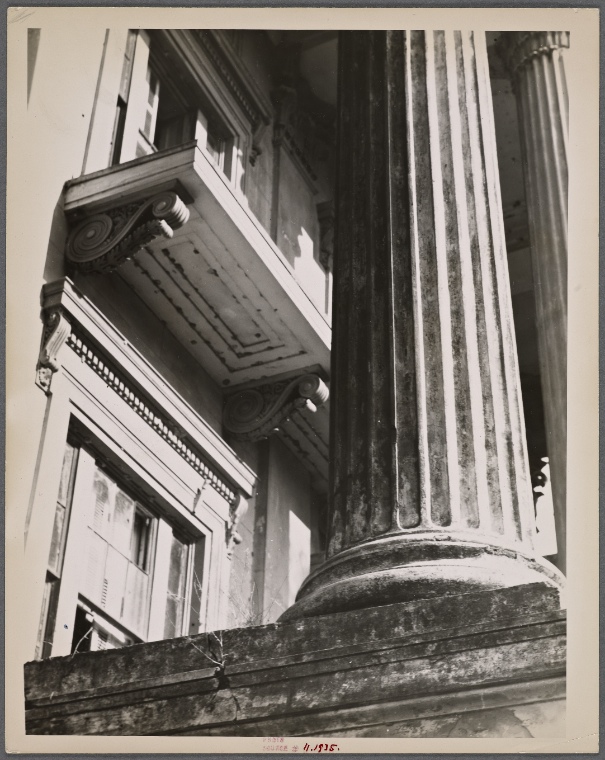
And yet... and yet....  Years ago, I came across a book called "Ghosts Along the Mississippi", by Clarence John Laughlin.  Originally published in 1948, it was filled with images of lost or soon to be lost buildings of the Old South.  (Some, happily, were later saved.)  The title was apt, of course, as the photographs captured all the ghostly decomposition of those once brilliant structures.  You could almost feel their shame at their present state - stripped, crumbling - collapsing with history and memory, as they closed in on themselves.  But there was one, more than any of the others, that caught my imagination.  One whose beautiful proportions and fine detail made its decay, its apparent loss, all the more distressing to me.  I've never forgotten that beautiful house.  Belle Grove. 

***

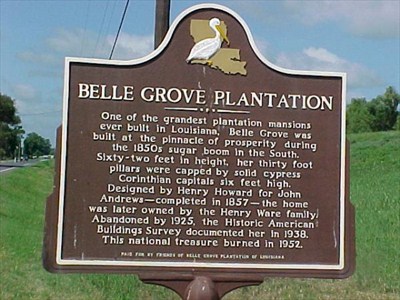
The mansion at Belle Grove Plantation was one of the greatest, largest and most beautiful residences ever built in the South.  Adapted from Wikipedia:


Belle Grove, also known as Belle Grove Plantation, was a plantation and elaborate Greek Revival and Italianate-style plantation mansion near White Castle in Iberville Parish, Louisiana. Completed in 1857, it was one of the largest mansions ever built in the South, surpassing even that of the neighboring Nottoway Plantation. The masonry structure stood 62 feet high and measured 122 feet wide by 119 feet deep, with seventy-five rooms spread over four floors.

Belle Grove was owned by John Andrews, a wealthy sugar planter.  Andrews owned over 7,000 acres spread over several plantations. By the 1850s, his more than 150 slaves were producing over half a million pounds of sugar each year. Andrews built the mansion from 1852 to 1857 at a cost of $80,000, not including the free (slave) labor or the plentiful cypress lumber and hand-made bricks produced on the plantation. The house was designed by New Orleans architect Henry Howard. 

Following the American Civil War and ensuing collapse of the plantation economy, Andrews sold the home and plantation in 1867 to James Ware, for the meager sum of $50,000. The Ware family continued to live and farm the plantation until the early 1920s. After several bad crop years, they were forced to sell the home. From 1925 onwards the house sat vacant.

The post-War era at Belle Grove saw the finely crafted home rot away in Louisiana's harsh environment. Neglect allowed a leaky roof to expand and destroy one wing of the mansion. Several owners purchased the home, each with aspirations of restoration, but none had the means necessary in the lean years of the Great Depression and World War II to stop the onslaught of rapid decay. On March 17, 1952, a mysterious fire during the night destroyed what remained of the house.


Many, if not most, of these photographs are the work of Walker Evans, taken in 1935.


 ***

Viewing these images gives me the most conflicted feelings; pondering this house, I recognize compartments of emotion and thought that can never open into each other, can never resolve.  So much of me feels wretched that such a beautiful thing is lost to the world.  I feel so strongly - always - that beauty should be preserved, honored.  The craftsmanship that was employed here was exemplary and irreplaceable.  And then what of the enslaved people who helped to build this magnificent house, who worked there; this was their house, too.  Their lives and work were in the wood and stone and brick of this house.  But part of me, pained by the thought of the incredible evil of the system that made possible its birth, feels that in some way it "deserved" to die.  Very possibly its dissolution and passing was just.  I don't know....


Friday, August 24, 2012

Great. Weight.

I've been hiking a lot lately, up in Forest Park, as I usually do when the weather is congenial.  Recently, the bottom of my left foot has been a bit sensitive, uncomfortable standing without a shoe on or without some other padding.  So I've been online, self-diagnosing.  Of course I have.  I've decided that it's probably a mild case of metatarsalgia or good old plantar fasciitis.  (I think I've dealt with the latter before - but the other foot? - which gradually went away.)

Explaining plantar fasciitis, that cheeky Wikipedia was coldly insensitive enough to say, "among non-athletic populations, it is associated with a high body mass index."  "High body mass"?  I do believe that that's just another way of saying that I'm too heavy for my own feet.  Which I believe is another way of telling me that I'm just too fat.  Thank you so much, Wikipedia, for informing me that I'm collapsing under my own weight.

[hysterical sobbing]

Saturday, July 21, 2012

Sleep wear trends for the post-op pooch

Two Mondays ago - the day after my birthday - our dear little dog, Nicholas, started feeling very ill.  We had a few really scary days, going back and forth to the hospital, before they finally figured out that he'd ingested part of a doggy toy.  That Wednesday he had surgery.  We had more vet and hospital visits in the days after that, mostly because we wanted to be very sure that everything was going the way it should be and that he was as comfortable as we could make him.  He's doing fine now and almost finished up with his convalescence.  He's been a total trouper through the whole thing; G and I were completely wrecked!

(G tells a more detailed version of the story on her blog.) 

One of the most challenging aspects in the week and a half or so since his surgery has been sleep time.  We arranged our schedules so that, during the day, one or both of us was here to watch him, because the biggest concern was that he'd try and fuss with his incision.  But at night we needed to put him in what they call an e-collar, so that he'd be protected from himself while we slept.  At first he was quite obviously very uncomfortable and none of us slept much at all.  It's progressively gotten easier.  Everyone's seen the sad little dogs and cats burdened with what looks like a inverted lampshade on their heads.  Nicholas' versions were slightly different, and he has kindly agreed* to model them for you.

Model number one:  Thick transparent plastic.  Black Velcro closure.  Matching piping at base.

Pluses:  See-thru and Astro-chic.

Minuses:  Stiff and too small; it was right up against his chin and he couldn't move his head at all.  Also gave him a bruise on his neck.

Verdict:  Thank you.  We've got enough problems right now.  We'll keep looking.


Model number two:  Stiff but quite pliable blue synthetic fabric.  White edging and drawstring.

Pluses:  Softer and more size-adjustable.  Adaptable - can be worn facing out for sleeping, or folded back for day wear.  (see below)

Minuses:  It's a collar.  For a dog.  And Nicholas doesn't find that color blue at all congenial.

Verdict:  It's still a big, floppy, annoying thing.  Thank you, but we'll keep looking.

[Folded back when worn during the day.]


Model number three:  Green cotton onesie, size: 3 months. Embroidery of an effeminate monkey on the side.

Pluses:  Our vet told us that Nicholas might be more comfortable sleeping in a onesie for the last few days of his convalescence.  It fits perfectly and is a nice chartreuse color.  The monkey embellishment is a nice - if rather ironic - reference to the cause of all his problems.  The manufacturer placed three snaps at the butt-end; if one only connects the two outer snaps, there is ample space left to accommodate a dog's tail.  It's cuuute!

Minuses:  He wiggled out of it the first night. 

Verdict:  He goes back to model number two for the duration.


*  No dogs - meaning Nicholas - were harmed in the production of this photo shoot.  Mr. O'Dittle is displaying that rather pathetic aspect merely to give the public some idea of his recent suffering.  In reality - finally, happily - he's feelin' fine!

Friday, June 29, 2012

Out of nowhere

[I don't know where this post comes from.  I don't know what got my thinking moved in this direction, but.... ]

I hate guns.  I hate everything about them.  I know we can't conceive of a world without guns, I know our laws guarantee a "right" to them.  I understand that people can get some sort of feeling of empowerment from shooting guns, can enjoy a thrilling transmission of power.  But even when they're used responsibly, when they're directed at nothing more sentient than a firing range target, I still hate them.

To me they're one of the most blatant symbols of our remove from the natural world.  That our machine-making minds have found a way to maim and kill - without effort - without contact.

If all I have to fight you with is a knife or a sword or my hands, if I have to look you in the eye and wonder the outcome, aren't I going to be a lot more cautious and rational when considering battle?  Just like a smart dog or lion or crow is going to make a judgement about whether a fight is worth it or not.  But if I have a gun - or a mortar or a big bomb - and you don't, I know I'll win.  Easy.  That core of a concept, our internalization of it, I think has had a sickening, dislocating effect on us as humans.

Violence is natural.  No matter how much we try to avoid it - usually a very healthy impulse - it's inherent in life and death.  In small and large ways.  But for violence to be understood, to be healthily processed by our puny human brains, I believe it has to present itself on a human scale.  The velocity of violence has to present in human time.

***

When I was living in San Francisco in the eighties, one of the many less-than-glamorous jobs I scrounged around to get was cleaning house for some people who had a t-shirt business in Mill Valley, across the bridge in Marin County.  The owner of the business always seemed more than a little paranoid.  Really kind of spooky.  He slept with a gun under his pillow.  And he was usually good about putting it away before I got dropped off - I was always alone in the house - but one or two times I had to pick up the gun and put it on the bedside table so that I could make the bed.  The only time I've held a gun.

It was so much heavier than I would have expected.  Heavy steel, machine cold.  Heavy.  Sickening, unnatural.  I found it very disturbing to even touch it.  It wasn't so much a fear I felt.  It just felt like an evil thing.  There are other weapons that can have another purpose, another life beyond violent intent.  A dagger or a sword can be beautifully decorated and ornamental.  It can be worn or hung on the wall and admired for its craftsmanship.  But I found no beauty in this heavy metal object.  And it was made for no other purpose.  For the few seconds it was in my hand, all I could feel from it, hear from it:  This is meant to kill with.  This is meant to kill with.

Monday, June 18, 2012

Decidedly not the same thing....

Preparing to paint - research, designing, Photoshopping, gridding, drawing - is not painting.  Buying art supplies and attending art openings is not painting.   Blogging and feathering my website is not painting.  Since finishing my current show at Winston Wächter and tossing off the small nude that's in the group show at Froelick, I haven't actually painted anything.

There isn't anything to paint.  I'm in the planning stages of several paintings - the beginnings of a whole show, really - but that doesn't give me any of the kind of satisfaction I get from being in the process of actually "building" a painting.  Putting stroke upon stroke of paint upon the panel.  Finishing each little section, moving forward in pictorial space.  Until some paint goes down onto the panel's surface, it's an idea, but it isn't a painting.  And I have nothing I can put paint on.

I used to whine constantly that it was sooo hard for me to just settle down and sit down to paint.  I was too nervous and scattered and dreaded the necessary intense deployment of concentration.  I could squander hour after hour, though, fussing with all the other parts of the art business that aren't actually painting.  And now?  Everything is reversed.  And even though I'm very frustrated over the dearth of paintable surfaces here in the studio right now, I'm very grateful for that reversal.

Friday, June 15, 2012

Two PTSDs walk into a bar....

So what happens when my lurking PTSD comes smack up against that of another struggling friend?  No joking matter, that.  It's unexpectedly wrenching.  In the midst of all the wonderful things that have been happening for me lately, I've had drama on the sidelines.  And I've directed much more attention and worry toward it that I probably should have.  I've added in my own little internal drama.

A very dear friend of mine is having a very difficult time right now, dealing with this insidious illness.  This isn't anything new, but part of its manifestation this time has been to turn on me, the angry rhetoric escalating, and then the grand gesture of officially and harshly discarding me as a friend.  We've never been anything but the most loving friends, always very supportive of each other, personally and in all our artistic endeavors.  So I was completely unprepared for this development, this turn.

Even more so, I've been startled by my own response to it.  I've been extremely anxious all week.  The queasy stomach, the feeling that "something bad" is going to happen.  (I have to admit, the timing hasn't helped; June 9th and 12th are the anniversaries of my dad's death and a car accident that G and I were in, the same year, three days apart.)  I know one of the commonest symptoms of PTSD is just that kind of anxiety.  A gnawing panic and a compulsion to try and tightly control all the aspects of your life.  Also anger, usually misplaced or misdirected.  I can tell myself over and over that my friend's rejection has absolutely nothing to do with me or anything I've done, that it's only the illness.  But it still hurts.  And the hurt makes me mad, because it's hard for me to just accept the hurt.  And the mad doesn't conjure anything productive.  Because you can't just slap the crazy out of someone.  (Though I can totally visualize that working - smack! and they come around - like they always do in the movies.  And, of course, that's crazy.)

I can pretty much see from the other side of it, understand a lot of the cock-eyed reasoning that's in play in my friend's mind, and have at least a small degree of perspective on the situation.  But the unexpected rejection still really gets to me.  An unearned rejection.  And one I can't fight, one I can't work my way back from with reasoning and support.  This seems to be a very tender spot in my emotional make-up; I guess it hasn't been entirely clear to me until now.  Maybe in the "big picture" of my life that's why this has happened, why this kind of situation is playing out again.  Because, happening this time, it brings up all the times in the past when I couldn't protect myself from the rejection, from being traumatized by the shock of it.  I suppose it happens to everyone.  I'm sure everyone has found themselves in that position, helpless.  I don't know, but maybe it's a bit more difficult for me to shake off than it is for most, considering my own struggles with PTSD.  But after I've taken care of myself, worked the methods that help with my own over-reactions, when I can start to turn the corner from the upset and get back some light and perspective... it still hurts.  And it doesn't hurt any less when I know it's not my fault, and that it really isn't the other person's fault.  It just hurts, and I guess I'll have to find a way to let that be.

Thursday, June 14, 2012

I love my wife. Period.

Happy birthday to my wonderful wife, G.  A most remarkable person.  I'm so blessed that she loves me so well and - perhaps more importantly - continues to willingly endure me.

This is the image from my birthday card to her this year.  We both go Photoshop wacky to celebrate any of our holidays.  After all the paintings of me festooned with diamonds, feathers, etc., it only seemed fair that she should bear the burden of outrageous glamour for a little while.

Friday, June 8, 2012

Des jeux sérieux de beauté

Tuesday evening we were in Seattle for the opening of my new show at Winston Wächter, Des jeux sérieux de beauté.  Some serious games of beauty.  Which I hope the work is, which I believe it is.


It was a lovely night.  Great turnout, friendly people.  And I actually wasn't all that nervous; I didn't have time to be.  Right at the beginning of the event, I had a few friends stop in to wish me well, and it just kept rolling on from there.  As soon as I finished talking to one person, someone else stepped in to talk with me.  I often feel conversationally awkward in these kinds of situations, but everyone was so nice, so generous, that it was all just a pleasure. 

It is a bit odd to talk exclusively about yourself and your art for more than two hours straight.  As someone who's rather full of himself, you'd think that it wouldn't bother me.  But it got to the point where the gross accumulation of me, me, me was a bit embarrassing; by the end of the evening I had a sore throat from talking about myself so much.

When G and I arrived at the gallery, several hours before the opening, Michael Upchurch, the arts writer for the Seattle Times, was already there, looking at the show and making notes.  He had reviewed the group show that was my introduction to Winston Wächter and had said nice - and really smart - things about my work.  So I was thrilled that he wanted to interview me for this show.  When we spoke on Tuesday afternoon, he couldn't have been nicer, and the resulting review/interview that appeared in the paper this morning couldn't have been more flattering.  It's been quite a week, and I'm very grateful for everyone's kindness.


Tuesday, May 29, 2012

Correcting a grievous cosmetic injustice

Recently, G and I felt like wallowing in extreme camp and got out our copy of Mommie Dearest; you'll have to agree that it more than fits that particular bill.  One of the worst directed and acted A-pictures of all time, in my opinion.  Sadly, I can't truly enjoy the wretchedness of the thing because, while watching nearly every scene, I'm distracted and obsessed by one thing - OK, two things:  the eyebrows.  The misbegotten, misshapen blobs of make-up that were applied to the forehead of Miss Faye Dunaway in a botched attempt to recreate the celebrated eyebrows of Miss Joan Crawford.

The Crawford eyebrows?  You set out to make a biopic of Joan Crawford and that's what you screw up?  Because there are so few pictures of Miss Crawford to work from?  Say what?  Her brows are the most recognizable thing about her appearance; even her shoulder pads have to take second place to the eyebrows.  (The taut and precise mouth comes in third.)  I'm veering clear of her very inspired performance, but at the time this film was made Faye Dunaway was physically pretty much perfect casting for Crawford.  It isn't Crawford's bone structure, honestly, but it really works.  And though I would have given her a darker red lip color in most of the scenes, they got the hair and wardrobe generally, close to... adequate.  Not embarrassing, anyway.  But how did they manage to mangle her eyebrows so badly? 

Early in her career, Crawford had as many variations in eyebrow shape and heft as she did hairstyle and hair color but, by the early forties when Mommie Dearest commences, the two little items had settled into their iconic pattern; with time they colonized more territory, but the shape remained the same: a fairly straight, un-arched line angling slightly up from the bridge of the nose, and then tilting down toward the temple.  (The right eyebrow was usually set a little higher and slightly more rounded; they got more exactly symmetrical as she got older and they got bigger.)  Dunaway's imposter brows are set way too high, start off curved where Crawford's are fairly blunt, and have an immediate big round arch.  (They also make them too heavy too early in the story, so one loses the impact of their ever onward and upward expansion upon her aging face.)  And to make matters infinitely worse, they're hard-edged and shiny with unpowdered eyebrow pencil, pointing out the fact that they're hair-free and completely bogus.  And, goddammit, the real Crawford eyebrows were quite obviously grown.

This level of artistic failure and professional incompetence on the part of Dunaway's make-up people and all others responsible deserves nothing less than the patented Crawford bitch-slap - something along the lines of the specific wailing she gives to Osa Massen toward the beginning of "A Woman's Face" would be appropriate, I think.  But since those responsible for this great cosmetic fiasco are not anywhere at hand, I have resorted to the corrective and healing powers of Photoshop.

 The Genuine Joan:
 The False Joan:
 The Revised False Joan:


***

In choosing the images, I went with some of the posed "publicity photos" that were created for the film, then tried to find pictures of Crawford that were similar.  I arranged both sets in some some of chronological order but, in my own defense, I don't know what period they were going for with (from left) the fourth and fifth pictures of Miss Faye, so I aimed at somewhere between the fifties and sixties.

As an added bonus, in the lightbox you can click back and forth between the second two images and watch Faye's eyebrows wiggle.  One of life's unexpected pleasures....


Wednesday, May 16, 2012

Seventeen

Yesterday, May 15th, was the seventeenth anniversary of my employment at Powell's Books.  Which is absolutely unfathomable to me.  I can't grasp what seventeen years looks like, what it feels like.  So much has happened in that time, but it also seems like that time hasn't passed at all.

(I guess I don't really understand how time functions.  I can't ever really pin it down.  I tend to be just a bit late for a lot of things, almost on time.  Though I nearly always make deadlines and appointments, it often feels as though there's some "higher power" making sure it all lines up for me.  I know some people speak of the passing of time as being an illusion.  That the past, present, and future exists, plays out, concurrently.  Maybe some sense of that concept rattles around in my brain and causes my vagueness.  For me, time floats.)

May of 1995 was also the month I began my career as a professional artist.  While the number of accumulated years still eludes my comprehension, as regards a professional artistic career, at least, seventeen years means something to me.  It means that I've worked hard, made a bunch of art, struggled a bit, learned a lot.  I can say, yes, I am an artist.  A mid-career professional artist.  That's who I am.  That's what I do.

For all of these seventeen years, being an artist and working at Powell's have been the twin aspects that were always the main focus of my attention. But in the last few years there's been a sharp change in the balance of that focus.  It's as though I've always had two lenses, and I would look from one to the other and back again.  For most of this time, my hours spent at Powell's got the bulk of my attention.  I put so much thought and energy - not always wisely deployed - into that environment.  And the view from that lens was always brightly lit and in focus.  By comparison, I was never able to see as clearly from the art lens.  My plans for advancing my career were always of the vaguest nature.  And I never had the time or energy to make enough art which, in turn, always sabotaged any plans I might have made clearer.  I always knew that in order to get further with my art career, I'd need to find a way to recalibrate my focus.

Thanks to some good counseling and working to get clear about what I really wanted to do with my life and career, and thanks to the perfect timing of the Artists Wanted award, I was able to go down to part time at work.  Which changed everything.  Now the balance is much healthier.  When I look through that day-job, part-time-work lens, things look fairly vague.  I can see it for what it is and give it its due, but it doesn't suck me in anymore.  When I look into the lens of my art-making career, the focus is sharp.  There are so many paintings to be made.

I don't know when the lens that represents Powell's will cease to exist.  Beginning, middle, and end aren't always easily distinguishable for me.  It's that time thing, I guess.  But any way I look at it, I'm grateful for the seventeen years so far, what they've taught me, and where they've lead.