L a - b e a u t é - s a u v e r a - l e - m o n d e ~ D o s t o ï e v s k i

L a - b e a u t é - s a u v e r a - l e - m o n d e  ~  D o s t o ï e v s k i


Sunday, June 27, 2010

Sunday morning with Freddie and Ginger

G and I went to a party for writers last night. A (slightly delayed) solstice party at the Writer's Dojo. (Sounds terribly literary, doesn't it?) We were totally pooped from work, but we allowed ourselves the option of leaving early if need be. It was a lovely evening, and G connected with a lot of the writers there. We spent the latter part, downstairs, talking with her friend Holly from the Dangerous Writers workshop. I love sitting back and listening to G and her writer colleagues discussing their work; fascinating. It wasn't at all late, when the host came down to put some food in the refrigerator. Then he came down again. And I thought, well things must be slowing down. It turns out we three were the very last ones there - rather embarrassing - and so much for leaving early. The host let us off the hook by explaining that, while the musician functions there usually go into the wee hours, the writers always leave early because they don't serve hard alcohol at the Dojo. Oh, those boozy, hard-core writers!

Is was about eleven-thirty when we left. First thing G said when we got in the car was, "I'm hungry." We'd barely eaten anything there: a piece of cheese, a cracker, and a nut. So, by the time we got home, we'd decided to eat our leftovers from the night before. Some wonderful squash enchiladas from Oba. In the door and on the way to the food, first thing G said was, "what are we watching?" This from the woman who's often in bed by ten. Or so out of it she should be. After the delightfully starchy meal, I dozed through much of the movie, but G was going strong. Until after two in the morning. Crazy world!

G was really running the show last night, so she chose "Roberta"; Astaire and Rogers is always a good choice, I'm thinking. Here is "Lovely To Look At/Smoke Gets In Your Eyes" which comes at the end of the fashion sequence, near the very end of the film. So brief. So perfect.

(Rogers' strange accent is explained by the fact that she's playing a phony Polish countess.)

Thursday, June 24, 2010

Beauty is enough

As simply as I can say it, I think beauty is sufficient reason for a work of art. It doesn't need to do anything else. It doesn't need to say anything. It most certainly doesn't need to make commentary on the world in which it was created. Beauty is sufficient.

When a work of art is clearly beautiful, when it is able to coherently communicate that beauty, it does something to us. Earliest man felt the imperative to make art, to create beauty, to communicate through art. When we're confronted with beauty, when it communicates its incomprehensibility to us, I believe it makes us something more than we were before. It feeds something in us; I truly believe that it changes our soul. And I believe it's something we truly need for survival, to be in touch with, to strive toward. To make us more. And we are so in need of that - that striving toward beauty, the communion with beauty - as a country, a planet, as humanity. Because I believe, as Dostoevsky said, that "beauty will save the world."

Wednesday, June 23, 2010

Respectfully....

I'm going to say again - and it won't be for the last time - that I have great respect for my fellow contemporary artists. That I rail against the state of contemporary art should never be seen as a criticism of what you do; and it doesn't even matter whether I happen to like your work or not. Seriously. Most of us have to devote a ridiculous amount of time to make what we make, giving up a lot, striving to realize our vision. And working hard. Long and hard. Being an artist is not for sissies.

Tuesday, June 22, 2010

Language is the problem

Most artists - and probably anyone else who ponders such things - would say that art is about communication. It may do other things as well, but most people would say that art will always say something. Fine. I can easily agree with that.

The problem - as I see it - is that, preparing to wade into the twentieth century, artists decided that in order to be Modern - the great addictive striving of the technological age - they needed to remake the vocabulary of visual art. They needed to devise a new language. New languages, actually: Impressionism, Post-Impressionism, Expressionism - all the "isms" - down to abstraction, Pop art, conceptual art. Schools of art that attempted to "break the mold" - you always need to break a mold in order to make anything good, you know - to show the world something new. And then another school, another new. Or just individuals following their own path, but always with the goal of making something new.

This has also been the age when artists went from being craftsmen to being something else. To being something special, something different. Visionaries. Celebrities. Artists. When artists were content to record "what is" - or even an imaginary "what could be", based squarely on "what is" - they were craftsmen, striving to be the best at their established craft. Even the revolutionary "art stars" of the past - the Michelangelos, Leonardos, Caravaggios - still worked within a fairly prescribed framework of pictorial representation. When artists decided that it would be better - newer - to imaginatively interpret "what is" - or more, "what isn't" - all bets were off. Anything was possible and, eventually, anything was permissible. Anything came to be accepted as art. At least anything new, anything approved by whatever current art establishment. That very rarefied strata that has eventually changed the definition and understanding and reputation of art.

Collecting fine art, living with it, has always been the privilege of wealth, but the imagery was always comprehensible to anyone; wealth and sophistication weren't prerequisites. But in the last century, art has become less and less accessible to the general public. Artists and the art establishment make art for themselves; they don't really make any effort to communicate beyond their own sphere. They have devised their own language. If you take the time, you may be able to learn that language; I'm sure it's worth the effort. But it is "elitist"; it has earned that criticism. If you demand that people must be instructed, that art must be explained, if you often refuse to give them anything of what many feel is the greatest purpose of art - beauty - then you leave many, perhaps most, of the world out. You have excluded them.

(Which is fine, I suppose. I see nothing wrong with strong-willed individualism. Do what you want. Make what you want. But don't be surprised or indignant when the public has become so disconnected from and/or uninterested in the arts that schools don't see a need to teach them and that our government looks on them with such disdain that they don't really care to support them financially.)

And so here's where I fall off the edge of the world. The edge of the art world, anyway. Because I believe art should be - relatively - accessible. It can be many other things: thought-provoking, beautiful, ugly, tranquilizing, incendiary, things I might not want to see, or something I just can't understand. But I believe at least I should be able - without instruction or explanation - to access the question. That is what I want in art and I really believe that most of the world wants it, too. If they even remember what art can be.

I don't mean this to be dogmatic; I think there should be room for everything, all forms of artistic expression. Chacun à son goût, as the French say. Each to his own taste. But the balance is horribly off. Craftsmanship needs to celebrated at least as much as nouveauté. And it isn't. And comprehensibility and accessibility should be seen as virtues. You can speak the language of the public - of "real people", people who need art, even if they don't know it - and still manage to say something meaningful.

Monday, June 21, 2010

In love with a white dress

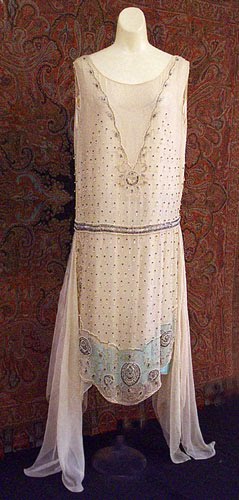
I just keep thinking about this dress I saw on the Vintage Textile website. I already included an image of it in a previous post, but I wanted to fixate on it a bit longer. In detail. This is a perfect example of the sort of dress to be worn by a young woman just prior to World War I. An absolutely refined, almost innocent elegance; I can picture one of the last Tsar's daughters wearing a dress exactly like this one. The fashions of those few years right before the war were often a strangely satisfying hybrid of delicate, layered fabrication and trimming, and an adaptation of classical Greek form. The asymmetric skirt panel on this dress and the semi-detached panels at the side of the bodice make me swoon.

Here is something of the website's description:

Hand-embroidered tulle tea dress, c.1912 [or later]

This [dress] combines hand-embroidered cotton tulle with a mixture of delicate machine laces. The hand-assembled tape lace around the neckline and on the skirt front is exceptionally pretty. The two outer layers are hand embroidered with a floral pattern of raised padded satin stitch with eyelet accents. The underskirt has a plain tulle top with a wide machine-embroidered hem flounce. The two layers of the bodice and three layers of the skirt close separately with snaps. [The dress was photographed without an underdress so that the various patterns can be seen.]

Respect

While I may criticise much of Modern art, contemporary art, for many things - its failure to communicate to the public beyond itself, its preciousness, hauteur, often underlying silliness - I need to make the deeply-felt distinction between my opinions about the work and the respect I feel for the artists who make it. Certainly, there are those I might find as distasteful as I find their "product", but I don't believe I've ever met a fellow artist who didn't believe in the work they do. Who didn't put long hours of thought and toil into the work they make. While I can't always enjoy the products of their vision, while I may wish they would see that communication to the public is more important than the striving for individuality or the pointless/vain struggle to be NEW, I must respect them for how hard they work and their belief in what they do.

Whatever the endeavor, it's a sort of divine, stubborn madness to work and work - to give up time for "otherwise living", to fail again, or come up short of your vision - to make art that half the world (or more) doesn't care about or thinks is useless. There is a sort of dogged, sacrificing foolishness at the core of any artist - or writer, musician, dancer, actor - that means something more than just the thing they make. I believe it puts something out into the universe, an energy that is possibly only produced by artistic expression. An energy that tells us to pause and look. To think. To challenge our sense of reality. The world is in constant need of change, constant need of fixing. I believe that art - all art forms - can be a portal to the sort of listening that must come before change.

So, as much as I rail about the state of the arts and its failures, as I see them - and will continue to do so - and no matter how loathed I may be by the "art world" for my heretical opinions, I want to say, unequivocally, that I have HUGE respect for artists - of any calling - their dedication, their madness, and what they give to the world. Cheers and amen!

Thursday, June 17, 2010

Scotto and Domingo in "Manon Lescaut"

[At the Met in the Eighties. Not always in sync, and there is a fair bit of necessary monitoring of the conductor, but what joy to see these two perfectly matched singing actors, surrounded by the gorgeous largess of the Met....]

The re-united passion of Manon and des Grieux:


Wednesday, June 16, 2010

Mimi's Death - speaking with Renata Scotto

This year, at 76, retired from the stage, giving an appreciation of the quiet simplicity of the death of one of opera's greatest heroines. A great singer and artist, Scotto was also a very great actress.

Tuesday, June 15, 2010

"Painter of...ec-c-ch!"

It may screw with my karma, but I have to admit no small satisfaction that it appears Thomas Kinkade has hit the skids. Born the same year I was born, graduated high school that same Bicentennial year I graduated, he made millions and millions from the mass-marketing of his wretched work. Copies of that wretched work. And now all his gold-spinning ventures seem to have devolved into lawsuits and bankruptcy. And a highly publicized DUI arrest. While I'm completely envious of those millions, and the clever marketing that got them, it's mystifying and extremely disheartening that someone with so little skill, with so little actual talent - so little - got so far.

But the fact of his one-time amazing popularity tells us something. The general public, the ones who don't go to museums or art galleries - maybe never in a lifetime - are still clambering for beauty; people want something of beauty in their lives. Accessible, pictorial beauty. Something that they can hang on their walls and live with. (I think this is some basic human need, to take something of beauty into one's home.) And the simple fact is that this avaricious, bible-thumping hack gave the public something it needed. Maybe without even knowing it needed it. Because our country is so totally uneducated in art history and has so little appreciation of any of the arts, and because contemporary artists make little that the uninitiated are capable of responding to, the great unsophisticated public - the numbers are probably inflated, but some say 1 in 20 homes in America has a Kinkade "product" - threw itself wholeheartedly into his grasping, sweaty hands. In some ways, they had nowhere else to go.

On so many levels, the great, puffed-up success of Thomas Kinkade is very, very sad thing. For this country, for artists, for art. And if he falls, nothing gets any better.

*

[Sorry, but I felt unable to post an example of his work, here; I do hope you'll understand....]

Sunday, June 13, 2010

Reckless

I just happened upon a terrific website: VINTAGE TEXTILES

They sell vintage clothing from the eighteenth century through to the Forties and Fifties. The presentation of the website itself is quite uninspiring, but the detailed photographs of the clothing are really wonderful. I'm - not surprisingly - most drawn to the items from the Edwardian period and from the Twenties and the Thirties. Along with all the details of each garment, discussion of condition, its history - if known - are often little wisps of fashion-mad wisdom. (Or maybe it's just cleverly high-toned salesmanship.) One I really enjoyed:

[Describing an Orientalist-style coat, ca. 1912, in orange corded wool, thickly embroidered in a Chinese cloud pattern in black, fur-trimmed and with collar and cuffs faced with an amazing Chrysoprase-colored velvet] "...[this] coat again proves what we have always known: style is individual, aristocratic, and reckless."

Well, I couldn't agree more.